
<img src="https://events.xg4ken.com/pixel/v2?tid=KT-N2BAB-3ED&amp;noscript=1" width="1" height="1" style="display:none">
Skip to the main content.

4 min read

Are You Ready to Buy a Home in Rochester, MN?

Are You Ready to Buy a Home in Rochester, MN?

Rochester’s housing market has gotten more competitive over the last several years. Between Mayo Clinic’s continued growth and a steady influx of new residents, demand has stayed high and prices have followed. That’s left a lot of renters hesitant to move forward, either assuming they’re not in a position to buy, or waiting until things “calm down.”

The thing is, the version of “ready” most people have in their heads usually doesn’t match what lenders actually look for. This post breaks down what readiness really means in Rochester’s current market, clears up a few common misconceptions, and gives you a starting point for figuring out where you actually stand.

Why Rochester Makes People Hesitant, and What That Hesitation Costs

It’s not hard to see why people pause. Median home prices in Rochester have climbed, rents have gone up alongside them, and it can feel like you’re stuck in a loop: not quite ready to buy, but also spending more each month to rent.

But waiting has a real cost too. Every month you’re renting is a month you’re not building equity. And in a market where home values have generally trended up, putting off the decision often means paying more for the same home later.

None of that means rushing into a purchase before you’re genuinely prepared. It just means it’s worth taking an honest look at where you stand, rather than assuming the answer is no.

 Before we get into the numbers, Episode #31 of the Good Money podcast covers the full rent vs. buy conversation in a way that might change how you look at this. You can listen right here!


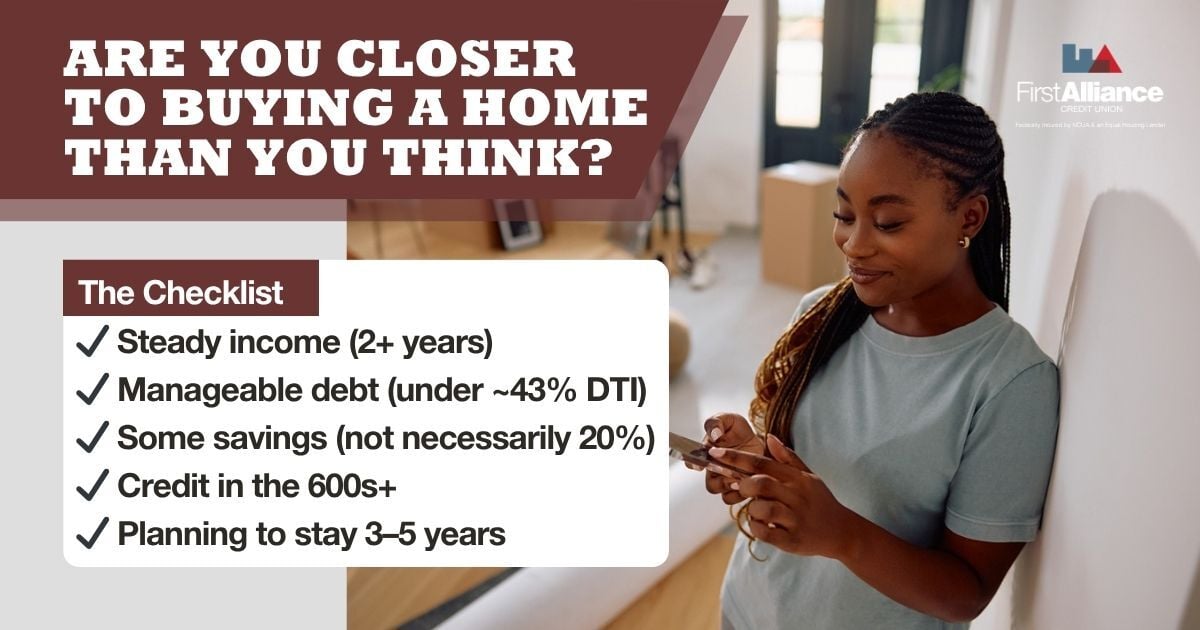
You Might Be Ready to Buy If…

Not every box needs to be checked. But the more of these that sound like your situation, the closer you probably are to being ready to buy a home. 

  • Your income is steady. It doesn’t have to be the same employer for a decade. Lenders generally want to see two years of consistent employment history in the same field. Self-employed borrowers can qualify too, typically with two years of tax returns.
  • Your debt is manageable. Lenders use your debt-to-income ratio (DTI) to assess this. A good benchmark: your total monthly debt payments, including a future mortgage, should stay below 43% of your gross income. Some loan programs allow a bit higher.
  • You have some savings. Not necessarily 20%. There are loan programs that start at 3–5% down, and some Minnesota-specific programs go lower for first-time buyers. You’ll also want to account for closing costs, which typically run 2–5% of the purchase price.
  • Your credit has some history. It doesn’t need to be perfect. Scores in the low-to-mid 600s can qualify for certain programs. More on this below.
  • You’re planning to stay in Rochester for a few years. Buying typically makes more financial sense with a horizon of at least three to five years. If your plans are less certain, renting might still be the better call for now.

Myth vs. Reality: Buying a Home in Rochester

There's a lot of outdated information floating around about what it takes to buy a home. Here are some of the most common ones we see holding people back.

Myth: You need a 20% down payment.

Reality: This is probably the most common thing we hear from first-time buyers, and it’s not accurate. Conventional loans can go as low as 3% down. FHA loans start at 3.5%. VA and USDA loans can be zero down for those who qualify. Putting more down does reduce your monthly payment and can eliminate private mortgage insurance (PMI), but it’s not a requirement to get started.

Myth: You need a 740+ credit score.

Reality: The minimum credit score to buy a house in Minnesota depends on the loan type. FHA loans can work with scores starting around 580. Conventional loans typically start around 620. A higher score will get you a better interest rate, but a lower score doesn’t automatically disqualify you. It just affects your options and rate.

Myth: Rochester MN is too expensive for first-time buyers.

Reality: The market is competitive, but “too expensive” depends a lot on your income, loan type, and how the purchase is structured. Entry-level homes and condos are still available in the Rochester area, and first-time homebuyer programs through the state of Minnesota can provide meaningful assistance toward down payments and closing costs.

Myth: You should wait until everything lines up perfectly.

Reality: Most buyers don’t feel 100% ready. They just reach a point where the numbers make sense and they have enough of a foundation to move forward. Getting pre-approved costs nothing and gives you real information to work with. That’s a lot more useful than waiting for the “right” moment to arrive on its own.

Common Questions About Buying a Home in Rochester, MN

Whether you're a first-time buyer or relocating, navigating the homebuying process can feel overwhelming. Here are answers to the questions we hear most often.

How much do I need to buy a house in Rochester, MN?

It varies depending on loan type. With an FHA loan, you’d typically need around 3.5% down plus closing costs. On a $300,000 home, that’s roughly $10,500 toward the down payment and up to $15,000 in closing costs, though those can sometimes be negotiated with the seller or offset through assistance programs.

What credit score do I need to buy a home in Minnesota?

For FHA loans, most lenders look for a minimum around 580. For conventional loans, you’re generally looking at 620 or higher. The better your score, the better your rate, but don’t count yourself out before you’ve had an actual conversation with a credit union mortgage lender.

Can I afford a home in Rochester with rising prices?

That depends on your income and what loan amount you qualify for. A lender can run those numbers with you. A general rule of thumb is that your total monthly housing payment shouldn’t exceed 28–30% of your gross monthly income, though this varies by situation.

What are the first steps to buying a home in Rochester?

Start by getting pre-approved. It’s free, it doesn’t take long, and it tells you exactly what you can afford based on your actual financial picture. From there, you’ll want to connect with a local real estate agent who knows the Rochester market. Starting with a real conversation is a lot more useful than browsing listings without knowing your numbers.

Are You Ready to Buy a Home in Rochester, MN b2

How First Alliance Credit Union Can Help

If you’re not sure where you stand, that’s a good place to start. At First Alliance Credit Union, we work with first-time homebuyers in Rochester regularly, including people who came in unsure whether they were ready and left with a clear picture of their options and next steps.

We offer a range of mortgage options commonly used by first-time homebuyers, along with low down payment programs and credit-building support for members who want to strengthen their financial position before applying. Our team is available to discuss your current situation and help you understand your options and next steps.

Not sure what your monthly payment might look like? Use our mortgage loan payment calculator to get a rough estimate, then reach out to our mortgage team for a free pre-approval conversation.