
How to Pick the Right Mortgage for Your Life (Not Just Your Budget)
How to choose a mortgage that fits your life. Compare loan types and fixed vs adjustable mortgage options to find the right home loan for you.
7 min read

Buying a home is exciting. But the moment someone starts talking about types of mortgage loans, FHA financing, conventional vs FHA mortgage decisions, and fixed vs adjustable rate mortgages, that excitement can quickly turn into overwhelm.
Here’s the thing: you’re not expected to know all of this already. The mortgage world has its own language, and it’s completely normal to feel confused when you’re trying to decode mortgage loan options while also thinking about paint colors and where the couch will go.
The good news? There’s no single “right” first time homebuyer mortgage for everyone. Your neighbor might love their FHA loan. Your coworker might have gone conventional. Your friend in the military might be raving about VA loans. They’re all right, for their specific situations.
The best mortgage is simply the one that fits your finances, goals, and lifestyle. And figuring that out is something you don’t have to do alone
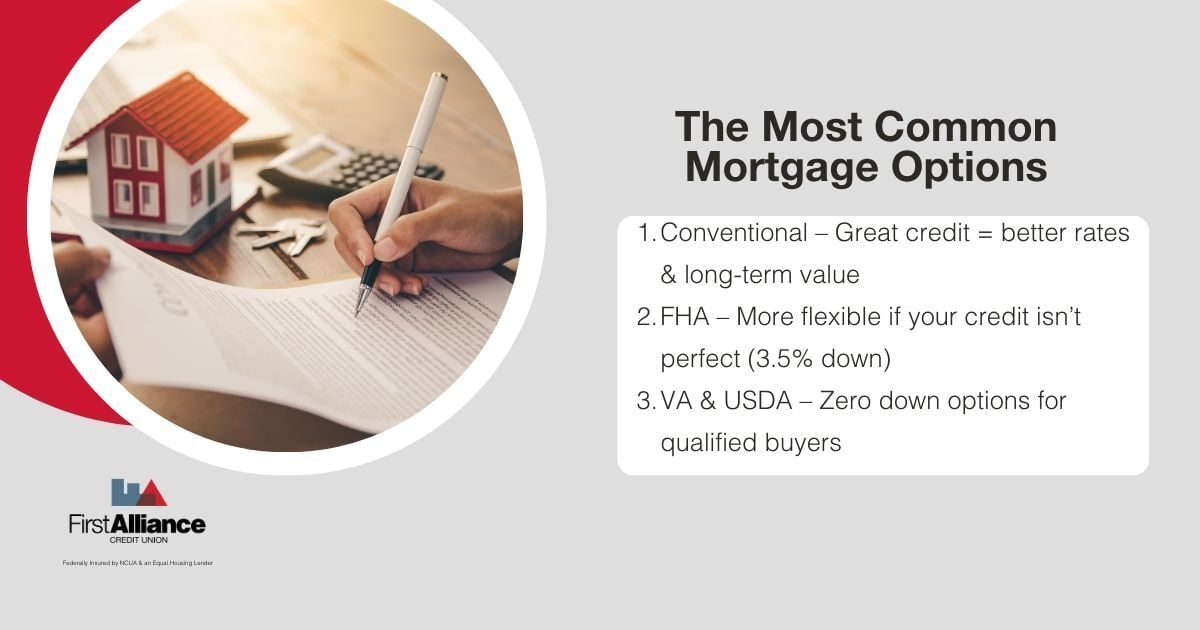
When you start looking at mortgages, you’ll hear about four main options most often. Each one works a little differently and has its own requirements. Let’s break down these mortgage loan options so you can figure out which might work best for your situation.
One thing to know about conventional loans is that your credit score can impact your interest rate more noticeably than with other loan types.
Lenders tend to group credit scores into ranges (almost like tiers). So if your score improves even a little, it can sometimes bump you into a better tier and potentially get you a better rate.
For example, someone with a score in the high 600s might qualify, but someone just over 700 could see better pricing. You don’t need to memorize these ranges. The main takeaway is simple: the stronger your credit score, the better your options tend to be.
And if your score isn’t quite where you want it yet, don’t panic. That’s extremely common, and there are still great loan programs available.
First things first: FHA doesn’t stand for “first-time homebuyer.” It’s the Federal Housing Administration, and you don’t have to be buying your first home to use one. You could be in your tenth house and still qualify (as long as it’s primary residence, not an investment property or second home).
You’ll need 3.5% down, which is slightly more than conventional loans at 3%, but the trade-off can be worth it if your credit history has some bumps. The interest rate structure is also simpler and doesn’t punish you as heavily for past credit issues.
If you’ve served in the military and have a certificate of eligibility, this is the loan you want.
Why? Three big reasons. First, you don’t need any down payment. Second, there’s no mortgage insurance requirement, even with nothing down. Most loans require mortgage insurance if you put down less than 20%, but VA loans skip that entirely, saving you potentially hundreds of dollars every month. And third, you’ll get the lowest interest rates available.
The only catch is you need to have served in the military and been honorably discharged. But if you meet that requirement, there’s really no reason to look at other options. This is the best deal out there.
USDA stands for United States Department of Agriculture, which sounds random until you understand what it’s for. These loans help people buy homes in rural or suburban areas, basically anywhere outside major cities.
Like VA loans, USDA loans require zero down payment. They’re designed for people who want to own a home but don’t have a large chunk of savings built up yet. There’s even a website where you can plug in an address to see if a property qualifies.
One thing to know: if you have 20% to put down, USDA might actually turn you away. These loans are meant for people who genuinely need the help, not those who could easily qualify for conventional financing.
You might be wondering, how do I actually know which loan is best for me?
The truth is, most of the time the right loan becomes clear once you look at a few key pieces of your financial picture. And don’t worry, you don’t need to have everything perfect. You just need to know where you stand.
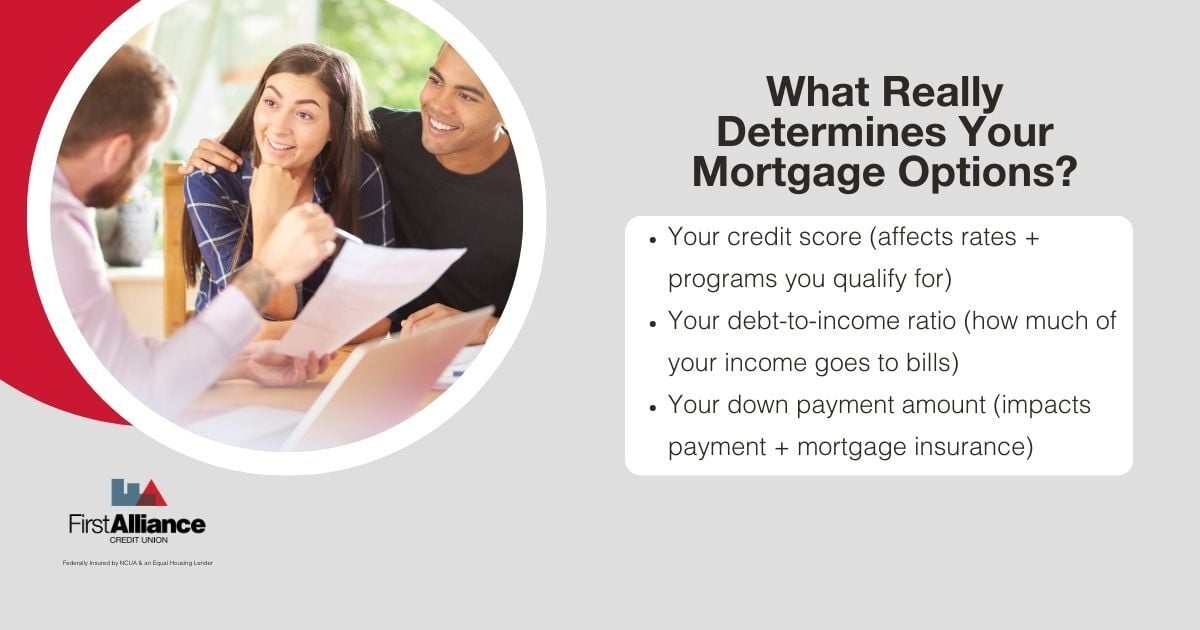
Here are the three biggest factors lenders look at:
Your credit score helps determine which loan programs you qualify for and what kind of interest rate you may receive.
If your score is on the lower side, loans like FHA or USDA may be more forgiving. If your score is higher and your credit history is clean, conventional financing may offer better long-term value. And if you qualify for a VA loan, that’s often the best option available.
This is just a fancy way of saying: how much of your monthly income is already going toward bills and debt.
That includes things like car payments, student loans, credit cards, and other monthly obligations. A lower DTI usually means more flexibility. FHA loans tend to be a little more lenient here than conventional loans.
Your down payment can affect your monthly payment, your interest rate, and whether mortgage insurance is required.
Even if you qualify for a zero-down option, having some savings can still give you more choices. But don’t let down payment pressure stop you from exploring your options. Many buyers are surprised by what they qualify for.
A good loan officer will help you compare everything side by side so you can make a confident decision based on your real numbers, not guesses.
Here’s something a lot of buyers don’t realize at first, and that’s totally okay. Even with a zero down loan, you’ll still need some money at closing.
VA and USDA loans can cover the down payment, which is an amazing benefit. But there are still other costs involved like insurance, property taxes, appraisal and title fees, and lender expenses.
It doesn’t mean homeownership is out of reach. It just means planning ahead matters. If you’re getting ready to buy, set a little aside so closing day feels exciting, not stressful.
Most buyers choose a 30-year fixed mortgage, and for good reason. The payment is usually more affordable, and it gives you more breathing room in your monthly budget.
But it’s also worth understanding one important thing: in the early years of a 30-year loan, a larger portion of your payment goes toward interest instead of your loan balance. That’s normal, but it surprises a lot of homeowners.
If you’re able to handle a higher monthly payment, a 15-year mortgage can be a powerful option. You’ll build equity faster, pay significantly less interest over time, and many 15-year loans also come with slightly lower interest rates.
The best choice depends on what feels comfortable for your budget and your goals. Some buyers want the lowest possible payment. Others want to pay off their home as fast as possible.

This podcast episode breaks down each mortgage option step by step, making it easier to compare your choices and move forward with confidence.
You may also hear about adjustable-rate mortgages (ARMs) or balloon loans. These are a little different from traditional fixed-rate mortgages.
With both options, your interest rate is fixed for an initial period, often five or seven years. After that:
These loans aren’t automatically bad, but they do require extra planning. If your rate increases later, your payment could go up, and that can catch some buyers off guard.
That said, an ARM can make sense in specific situations, like if you’re confident you’ll sell the home within a few years or you know your income will increase soon.
The key is simple: these loans only work well if you have a clear exit plan and feel confident you could handle a payment change down the road.
When you start shopping for a mortgage, lenders will give you a document called a Loan Estimate. It’s one of the most important things you’ll review during the process.
At first glance, it can look a little overwhelming. But once you know what to look for, it becomes a really helpful tool.
The Loan Estimate shows your:
One of the most important areas is the section that lists origination charges and discount points. This is where you’ll see what the lender is charging you directly, and it’s the best way to compare one lender to another.
Two lenders might offer the same rate, but one could be charging significantly higher fees behind the scenes. The Loan Estimate helps you spot that clearly so you can make a confident decision.
The perfect loan for you depends on your credit, your financial situation, how long you plan to stay in the house, and where that house is located.
But here’s what matters most: there are more options than ever for getting into a home, even if you’re not bringing a 20% down payment to the table. Whether you’re working with less-than-perfect credit, stretching your budget, or just starting your career, there’s likely a loan program that can work for you.
The key is talking to someone who can walk you through your specific situation. Not someone trying to push you into the loan that’s easiest for them, but someone who genuinely wants to help you understand your options.
First Alliance Credit Union knows that buying a home is one of the biggest financial decisions you’ll make. It should feel exciting, not overwhelming or confusing.
Our local mortgage loan officers are here to walk you through your options without pressure or jargon. We’ll look at your specific situation, explain what makes sense and why, and help you feel confident about the path forward.
You don’t need everything figured out to start the conversation. Sometimes just understanding what’s actually possible can make everything feel less heavy.
Ready to explore your mortgage options? Let’s talk through what makes sense for you. No pressure, just honest guidance from people who actually care about helping you find the right fit.
Because understanding your options isn’t just about getting a loan. It’s about feeling confident that you’re making the right choice for you and your family.


How to choose a mortgage that fits your life. Compare loan types and fixed vs adjustable mortgage options to find the right home loan for you.
 Kamel LoveJoy : Mar 26, 2025, 4:56:36 PM
Learn about What is PMI on a Mortgage & how it relates to FHA loans, its costs, how long it lasts & strategies to eliminate it for better planning.

 First Alliance Credit Union : Jul 19, 2017, 5:57:00 AM
Mortgage lenders look at a lot of information when it come to qualifying for a mortgage, but it comes down to credit, equity, income and assets.