
 Allethea Faye Monfiel
How to Start an Emergency Fund
 Jenna Taubel : May 2, 2019, 6:08:00 AM
Once you have made the choice to start saving for your future, building up your emergency savings fund should be your first goal. This means having...

Most kids have a running list of things they want. And most parents know exactly how that conversation goes: "Can you just buy it for me?"
Here's the thing. That moment is actually useful. When a kid has a savings goal they're working toward, the answer stops being "no" and starts being "let's figure out how." They learn that wanting something isn't enough, and that waiting for it feels a lot better than you'd expect.
Here's how to make that work in your house.
This one matters more than people think. If you pick the goal, the motivation won't last. Kids need to feel like they chose it.
Let them name it. A video game, a skateboard, a specific pair of sneakers they've been talking about for three months. It doesn't matter what it is, as long as they want it badly enough to wait for it. That's the whole thing.
For younger kids, around ages 6 to 9, start small. Something they can save for in a few weeks, not months. You want them to experience the whole thing: pick a goal, save up, buy it themselves. Once they do it once, they get it. They'll want to do it again.
Older kids can handle bigger goals and longer timelines. You can even run two goals at once, one they're close to hitting and one that's further out. It keeps the habit going between wins.
Whatever they pick, write it down somewhere they'll actually see it. A sticky note on the dresser. Their name on the savings jar. It sounds small, but keeping the goal visible keeps it real.
"I want to save up for a bike" is not a plan. "I need $85 and I can save $10 a week" is a plan.
Sit down together and work out the numbers. How much does it cost? How much can they set aside each week? How long will that take? Let your kid do the math with you. When they figure out that $6 a week gets them to $60 in 10 weeks, the goal suddenly feels real and doable instead of just far away.
While you're at it, talk about where the money is coming from. Allowance, extra chores, birthday money from grandma. Having a plan for how the money comes in is just as important as knowing where it's going.
Abstract saving doesn't motivate kids. Seeing the money grow does.
Pick something visual that works for your kid's age:
It doesn't have to be fancy. It just has to be visible. Kids who can see their progress tend to stay with it.
At some point it also helps to move the money somewhere official. When savings go from a jar on the dresser to an account with their name on it, something shifts. It feels more serious. It also makes it harder to casually spend, which is a good thing.
You'll give your child a real place to save and an early feel for how banking works when you open a Youth Savings Account at First Alliance Credit Union. It's a small step with a bigger effect than you'd expect.
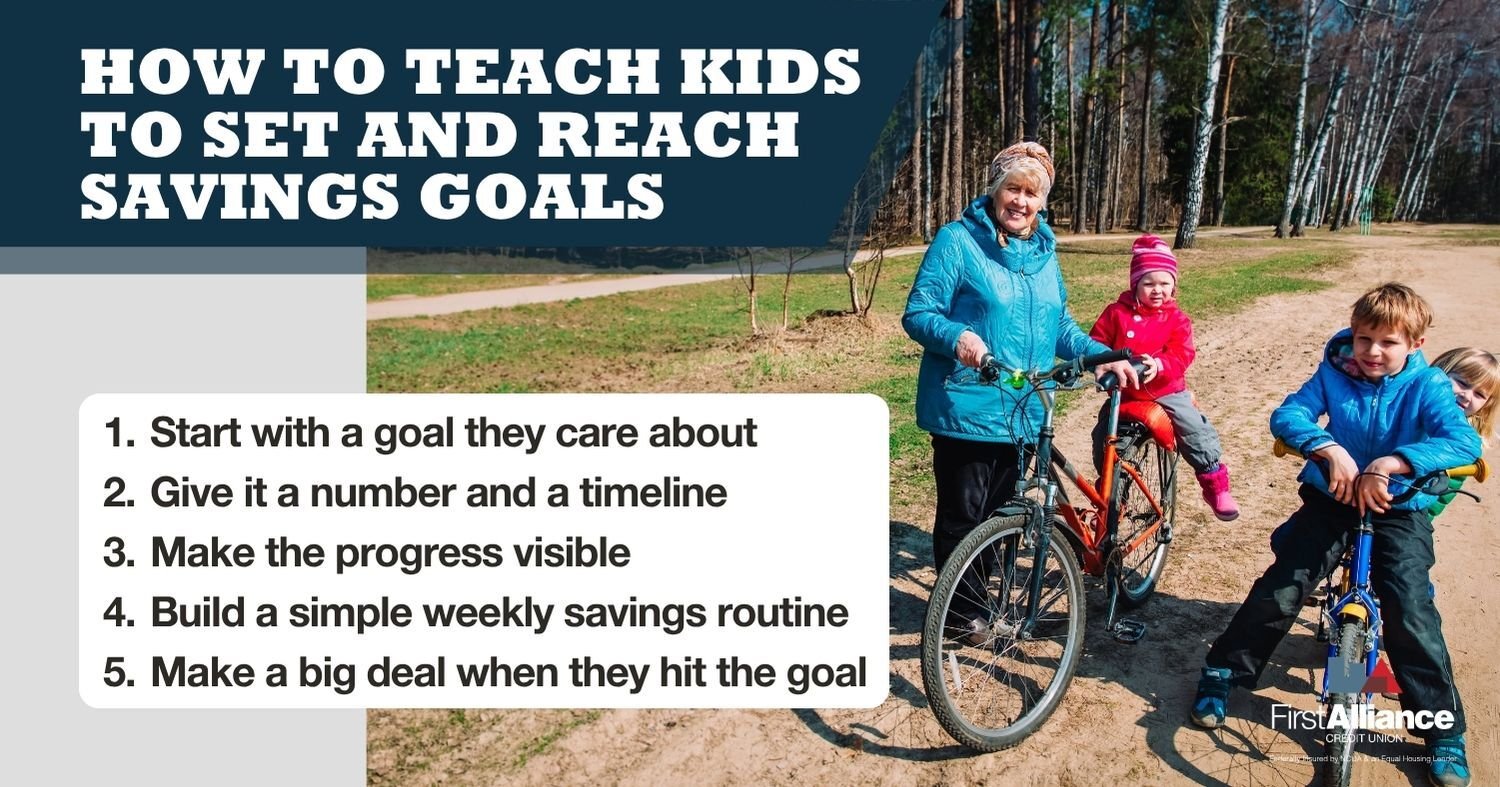
Saving works best when it's not a decision your kid has to make every week. The families that stick with it usually have a system, something simple that runs on its own.
A good starting point is save first, spend second. Whatever money comes in, a set amount goes to savings right away before anything else. It doesn't have to be a large amount. A dollar out of every five is enough to build the habit. The consistency is the point, not the size of the contribution.
For older kids with a steadier income, whether that's a weekly allowance or jobs they pick up, automatic transfers are worth setting up. The money moves on its own and nobody has to remember to do it.
If you want something that brings it all together, the Greenlight Debit Card and Family Money App lets you manage allowances, set savings goals, assign chores, and keep an eye on spending in one place. It makes the whole system a lot easier to run, especially if you have more than one kid.
When your kid finally has enough, don't just hand over the money. Let them do it. Let them pull the cash out of the account, tap the card, walk up to the register themselves. That moment of being the one who made it happen is the whole lesson.
Once the excitement settles, ask what's next. It doesn't have to be a big goal. Even a small one keeps the habit alive while the feeling is still fresh.
Kids who go through the full loop once tend to want to do it again. That's what you're after. Not a one-time lesson, but a habit that starts to feel natural. Once it clicks, it usually sticks.
The habits kids build early tend to follow them. It doesn't take a complicated system to get started. It takes a goal they care about, a simple routine, and somewhere real to put the money.
You'll find everything your family needs at First Alliance Credit Union, from Youth Savings Accounts to tools and resources built for families at every stage.

 Jenna Taubel : May 2, 2019, 6:08:00 AM
Once you have made the choice to start saving for your future, building up your emergency savings fund should be your first goal. This means having...

 Chris Gottschalk : May 21, 2020, 5:50:00 AM
When you get a savings account, you'll want to see if you have to pay any fees. Here are some savings accounts fees to watch out for.
 Chris Gottschalk : Aug 29, 2019, 4:40:00 AM
The most basic step you can take when starting to save money is opening a savings account. Sometimes, though, this can seem like an unnecessary...