1 min read
You Need a Budget: How to Take Control of Your Money
Imagine a friendly couple walking through our doors at First Alliance Credit Union—mom and dad looking slightly stressed about money, and their eager...
6 min read
Allethea Faye Monfiel : Updated on April 13, 2026
If you've ever watched your child hand over a crumpled dollar bill at the school fair or nervously count coins at the grocery store, you already know they're curious about money. That curiosity is a gift, and the way you nurture it now can shape how they handle finances for the rest of their lives. One question that comes up a lot for parents these days is: when should kids get a debit card? There's no single right answer for every family, but there are some really helpful signs to look for, and we're here to walk you through all of it.
We live in a world where cash is becoming less and less common. Your child is growing up watching you tap your phone to pay for coffee, check out with a card at the grocery store, and send money digitally in seconds. If they never learn how digital spending works while they're still under your roof, they'll be figuring it out on their own later, often the hard way.
That's exactly why so many families are starting to ask about debit cards for kids. Unlike credit cards, debit cards only let you spend what you already have. That built-in limit is actually a huge teaching advantage. When the money's gone, it's gone, and that's a lesson that sticks.
The benefits of giving a child a debit card go beyond just convenience. It's a real-world classroom. Kids learn to check their balance, think before they spend, and understand that money is finite. And when they make small mistakes with small amounts, you're there to help them course-correct before the stakes get higher.
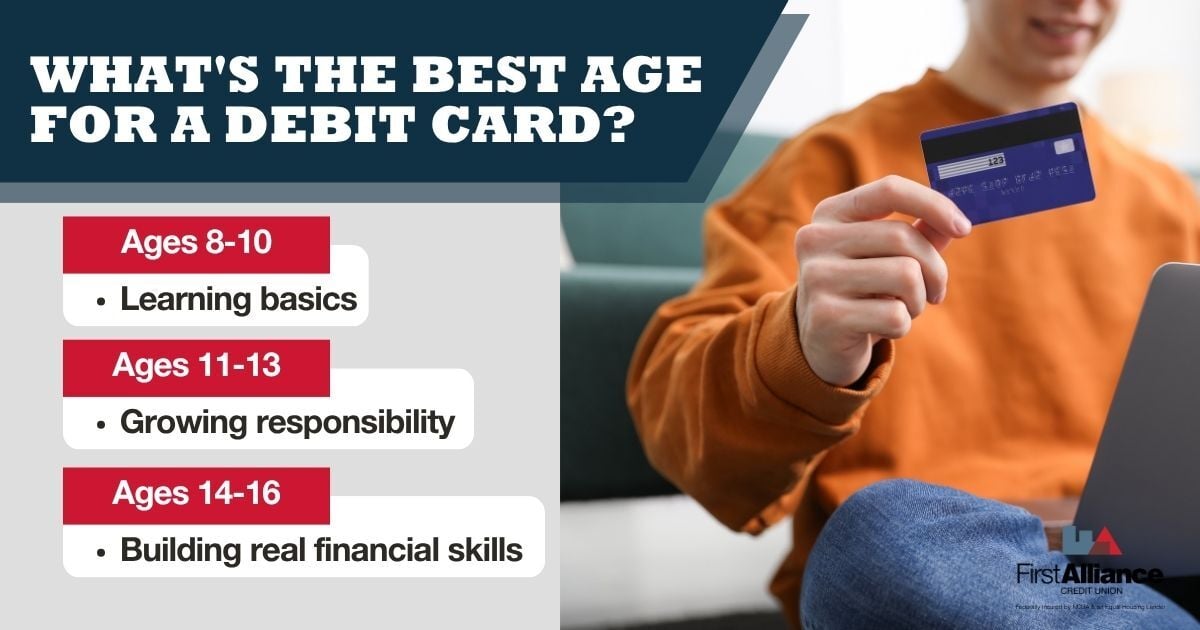
Here's the honest answer: age matters less than readiness. That said, there are some general patterns that can guide you.
At this stage, kids are starting to understand that money comes from work and gets spent on things. They can grasp the idea of saving up for something they want. This is a great time to introduce a youth checking account with a linked debit card, especially one with strong parental controls. The goal here isn't independence, it's supervised practice.
Middle schoolers are starting to have a social life that involves spending money, whether it's buying lunch, grabbing a snack with friends, or shopping online. This is a natural turning point. A debit card for teenagers at this age can help them practice budgeting with more independence, while you're still close enough to catch any habits that need adjusting.
By high school, many teens are earning their own money through part-time jobs or side gigs. This is the right time to transition from a monitoring-heavy card to something that feels more like a real account, because it is. Opening a First Alliance checking account and debit card at this stage gives teens a taste of actual banking while still having a trusted adult in their corner.

Before handing over a card, it helps to make sure your child has a handle on a few key concepts. You don't need them to be a finance expert, but they should be able to:
If your child can handle those basics, they're likely ready for a card with some supervision. And if they're not quite there yet, that's completely okay. Use it as a starting point to practice together.
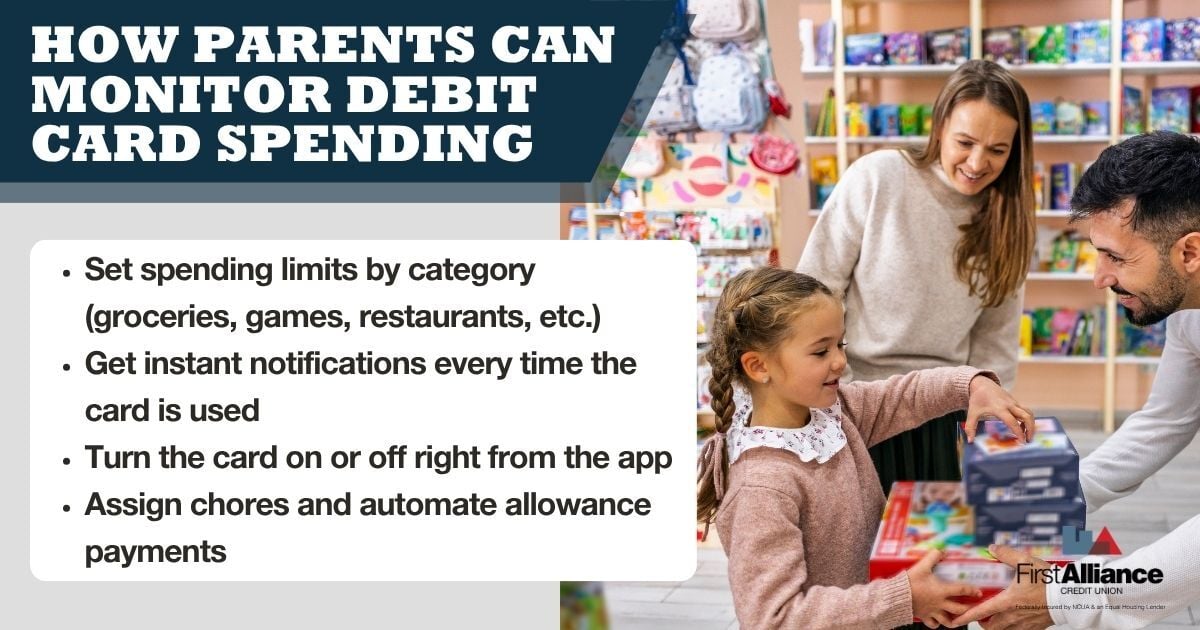
One of the biggest concerns parents have is losing visibility into their child's spending. The good news is that the right tools make how parents can monitor debit card spending easier than ever.
With First Alliance's youth accounts, parents have access to the account and can see transactions in real time. There are no surprises, just clear insight into where the money goes. For younger kids, First Alliance also offers Greenlight debit cards* through a partnership that gives parents even more control:
It's monitoring that doesn't feel like surveillance because it comes with conversation built in. When your child sees that you can see their purchases, it naturally creates moments to talk about money without it feeling like a lecture.
This is a question that comes up a lot, and the answer depends on your goals.
A prepaid card works like a gift card. You load money onto it, your child spends from that balance, and there's no bank account attached. It's simple and controlled, but it doesn't teach kids how actual banking works. They're not building any kind of financial history, and there's no relationship with a financial institution they can grow into.
A youth checking account with a debit card, on the other hand, is a real account. It comes with real banking habits: checking balances, understanding deposits, maybe even earning a little interest. And as your child grows, that account grows with them.
For most families, the sweet spot looks something like this: start younger kids with a Greenlight debit card linked to a First Alliance account for maximum parental control, then transition to a full First Alliance checking account and debit card as they get older and more independent. That way, they're always building on something real.

A debit card is a tool, not a teacher. The real financial literacy for children happens in the conversations you have around it. Here are some easy ways to weave money talk into everyday moments:
A lot of parents who come to First Alliance share something really meaningful: they didn't grow up learning about money, and they don't want their kids to feel the same way. If that resonates with you, just know that you're already doing the right thing by asking these questions. You don't have to be a financial expert to raise a financially confident kid. You just have to be willing to start the conversation.
At First Alliance Credit Union, we believe that teaching kids about money is one of the most powerful things a family can do together. Our youth accounts are designed with families in mind, with features that grow alongside your child and tools that make it easy for parents to stay involved.
Whether your child is 8 and just starting to understand how money works, or 16 and ready for their first real checking account, we have options that fit where your family is right now.
You'll find everything you need to get started at your nearest First Alliance branch or online. Our team is happy to walk you through youth account options, help you set up a Greenlight card for your younger child, or open a checking account for your teenager. Because raising money-smart kids is something we love helping families do.
The Greenlight® prepaid card is issued by Community Federal Savings Bank, member FDIC, pursuant to license by Mastercard International.
ᐩFirst Alliance Credit Union account holders are eligible for the Greenlight SELECT plan at no cost when they connect their First Alliance Credit Union account as the Greenlight funding source for the entirety of the promotion. Subject to minimum balance requirements and identity verification. Upgrades will result in additional fees. Upon termination of the promotion, account holders will be responsible for associated monthly fees. Account holders may also choose to upgrade to one of Greenlight’s Partner premium plans: Infinity Select or Family Shield Select. First Alliance Credit Union account holders will receive a $5.99 monthly discount on either plan when they connect an eligible account as their Greenlight funding source. Offer ends 10/15/2026. Offer, pricing, and First Alliance Credit Union participation subject to change. Terms and conditions apply. See First Alliance Credit Union and Greenlight terms for full details.
*Requires mobile data or a WiFi connection, and access to sensory and motion data from cell phone to utilize safety features including family location sharing and driving alerts and reports. Messaging and data rates and other terms may apply.
**Premium monitoring services are offered by Experian.
^Insurance offered by Acrisure, LLC is provided by ACE American Insurance Company and its U.S.-based Chubb underwriting company affiliates. www.chubb.com. Additional details can be viewed here. See link for policy information. Insurance Products are not insured by the FDIC or any federal government agency and are not a deposit or other obligation of, or guaranteed by, any bank or bank affiliate.
^^© 2025 Greenlight Investment Advisors, LLC, an SEC Registered Investment Advisor provides investment advisory services to its clients. Investing involves risk and may include the loss of principal. Investments are not FDIC-insured, are not a deposit, and may lose value.
1 min read
Imagine a friendly couple walking through our doors at First Alliance Credit Union—mom and dad looking slightly stressed about money, and their eager...
1 min read
Hey there! Imagine if every time you got paid or received money, it magically appeared in your bank account—no waiting around for a check in the...
1 min read
One of the most exciting parts of getting a tax refund is figuring out what to do with it. You might be aware that if you use your tax refund wisely,...