


<img src="https://events.xg4ken.com/pixel/v2?tid=KT-N2BAB-3ED&amp;noscript=1" width="1" height="1" style="display:none">
Skip to the main content.

4 min read

Rebuilding Your Savings After a Major Set Back

Rebuilding Your Savings After a Major Set Back

Maybe you watched your savings account hit zero after a medical emergency. Maybe it was a stretch of unemployment that lasted longer than anyone planned for. Maybe the bills just kept stacking up faster than you could keep pace. However you got here, the savings cushion you worked hard to build is gone. And that stings.

But here’s what we want you to know before we get into anything else: using your emergency fund for an emergency is not a failure. That money did its job. Now it’s time to focus on yours, and that starts with figuring out how to build it back up, one small step at a time.

Why Your Emergency Fund Should Come First

When you’re climbing out of a financial hole, throwing every extra dollar at debt might seem like the right move. And yes, paying down debt matters. But without any savings cushion at all, the next unexpected expense sends you right back to square one, possibly deeper into debt than before.

An emergency fund is your financial buffer. It’s what keeps a flat tire from becoming a credit card balance. It’s what keeps a broken furnace from turning into a personal loan.

Having even a small cushion changes everything. It means you have options when life gets rocky, and that peace of mind is worth more than you might think.

The goal most financial experts recommend is three months’ worth of your salary saved. That can feel like a mountain when you’re starting from zero. But you don’t have to get there overnight. Start with $500. That one milestone alone puts you in a far more stable place than having nothing at all.

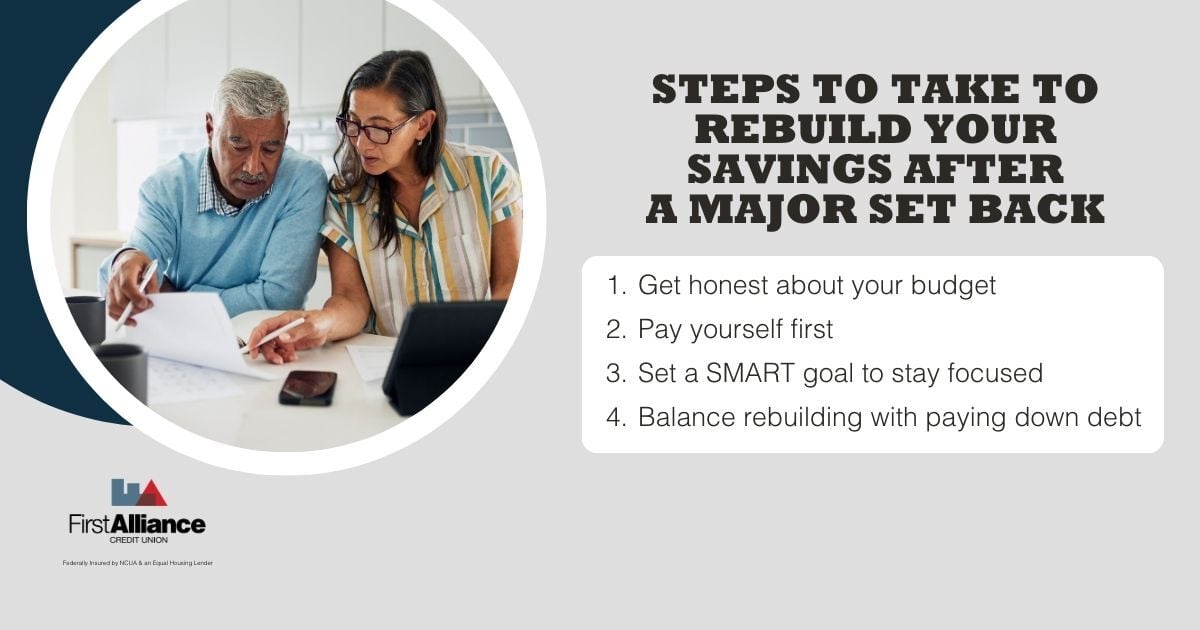
Step One: Get Honest About Your Budget

Before you can start saving again, you need a clear picture of where your money is actually going. Not where you think it’s going. Where it’s really going.

Pull up your last two or three months of bank statements. Look at them honestly, without judgment. Ask yourself:

  • What spending here was truly necessary?
  • What subscriptions am I paying for that I barely use?
  • Where does money quietly disappear without much thought?

You might be surprised how much room you can create with just a few small adjustments. Even finding an extra $50 a month is a real start.

If you’d like help walking through this, visit the website for First Alliance Credit Union to explore our financial education resources and tools. You can learn more about budgeting strategies, savings tips, and other resources designed to help you better understand your financial situation and build a plan that works for your life.

Want more guidance on saving? Check out our podcast episode on how to build an emergency fund for practical tips you can start using today.


Step Two: Pay Yourself First

This is one of the most effective habits you can build, especially when you’re rebuilding. The idea is simple: when you get paid, move money into savings before you do anything else—even if it’s just $10 or $25 per paycheck.

The trick is to automate it so you never have to think about it. You can set up an automatic transfer through your online or mobile banking, such as with First Alliance Credit Union. When savings are automatic and out of sight, it’s easier to stay consistent. Over time, those regular transfers can help your savings balance steadily grow.

Another helpful tool is the Round Up Program. Every time you swipe your debit card, your purchase is rounded up to the nearest dollar, and the difference is automatically transferred into your savings account. It’s effortless and can add up faster than you might expect.

Many people find this one change is what finally makes saving feel possible. You’re not relying on willpower—the system does the work for you.

Step Three: Set a SMART Goal to Stay Focused

Vague goals like “I want to save more” rarely stick. What actually works is making your goal SMART: Specific, Measurable, Achievable, Relevant, and Time-bound.

Here’s what that could look like for someone rebuilding:

  • Specific: I will build a $500 emergency fund.
  • Measurable: I will track my balance every Friday in mobile banking.
  • Achievable: I will transfer $50 from each paycheck into savings.
  • Relevant: This cushion will protect me from going back into debt when something unexpected comes up.
  • Time-bound: I will reach $500 within five months.

Once you hit that first goal, celebrate it. Then set the next one. Momentum is real, and small wins have a way of building on each other.

Take control of your finances today. Download our Smart Goals Packet to access tools and tips that help you set realistic goals and create a plan that works for your life right now.

Step Four: Balance Rebuilding With Paying Down Debt

If you’re carrying debt at the same time, you don’t have to choose one or the other. You can do both.

One approach that works well: if you have multiple credit card payments scattered across different balances, look into consolidating them into one lower monthly payment. That frees up extra cash each month. Then split it: half toward extra debt payoff, half into savings. You’re making progress in both directions at once.

This is something our team at First Alliance can help you map out. A loan consolidation might free up more breathing room than you realize. Stop in and let’s talk through the options.

how to build your savings after a financial set back

The Right Place to Keep Your Emergency Fund

Where you keep your emergency fund matters. You want it somewhere safe, accessible, and ideally earning a little interest while it sits. A few great options at First Alliance:

  • Regular Savings Account: Simple, accessible, and a solid starting point.
  • WINcentive Savings®: Every deposit enters you to win cash prizes. It makes saving feel a little more motivating, which matters when you’re rebuilding.
  • Money Market Account: Once you’ve saved around $2,000, consider moving your emergency fund here to earn a higher interest rate and grow your balance even faster.

Not sure which is the right fit right now? Stop in and we’ll help you figure it out.

One More Thing: Be Patient With Yourself

Rebuilding is not a straight line. Some months you’ll add more, some months less. Some months something unexpected will happen and you’ll need to dip back in. That’s okay. That is exactly what the fund is there for.

The mistake isn’t having an empty savings account after a hard season. The only real misstep is not trying to rebuild. And the fact that you’re reading this right now means you’re already doing the right thing.

Your budget will change over time. Your savings habits will grow. One day you’ll log into mobile banking and see a balance that genuinely surprises you. It happens faster than people expect once the habit clicks into place.

We’re here for all of it. Visit our website to explore resources and tools that can help you build a plan that works for where you are right now.

Have questions or need guidance? Connect with our team to tools to build a plan that works for your life today.

Top Strategies to Manage Financial Stress and Anxiety

Top Strategies to Manage Financial Stress and Anxiety

That tight feeling before payday. The late-night math on your phone. The worry that one surprise bill could throw everything off. Financial stress...


Read More
How to Stop Living Paycheck to Paycheck

How to Stop Living Paycheck to Paycheck

Prema has a beautiful family, two energetic kids, Kay and Milly, and a hardworking husband. Her husband’s new job will pay more after training, so...

Read More
How to Open a Savings Account in 5 Easy Steps

How to Open a Savings Account in 5 Easy Steps

There are a lot of paths to financial success, but arguably the first step that everyone must take is opening a savings account. When you have a...

Read More