
 Chris Gottschalk
What is a Checking Account?
 Jenna Taubel : Feb 5, 2019, 7:27:00 AM
Discover the benefits of checking accounts for everyday expenses and learn how they differ from savings accounts. Find the right option for you.

If you're setting up direct deposit for your paycheck, you might wonder whether it has to go into a checking account or if you can use a savings account instead. Yes, you can direct deposit your paycheck into a savings account, but a checking account is often more convenient for everyday expenses like paying bills, making purchases, and transferring money. Savings accounts are better suited for setting money aside, and some may limit certain withdrawals or transfers.
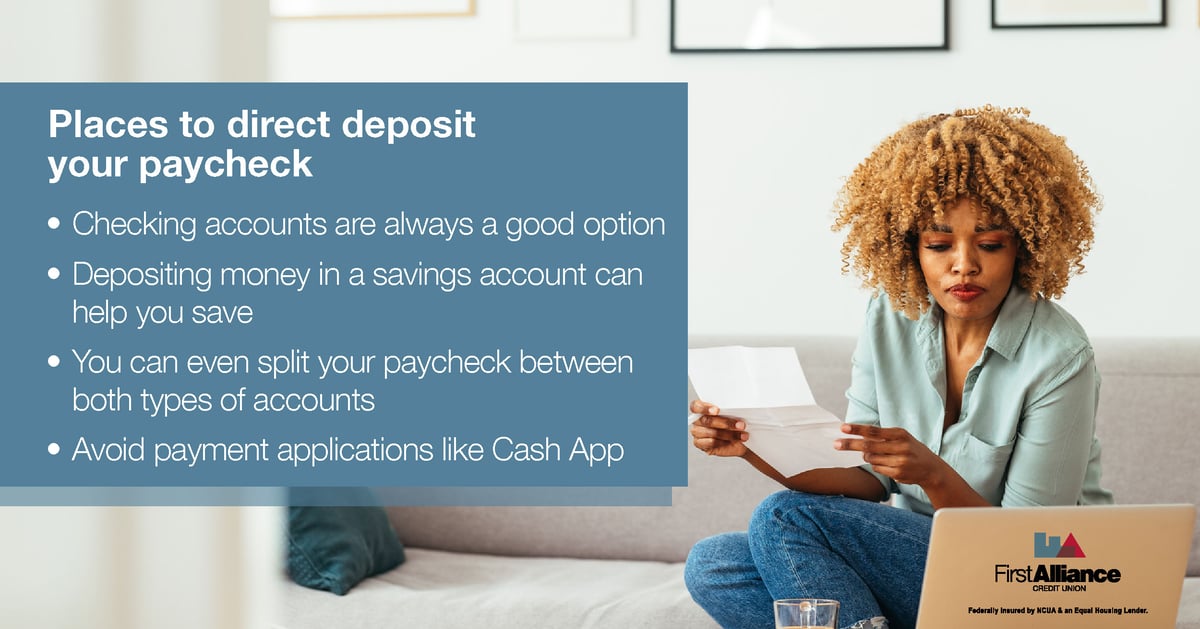
You can also split your direct deposit between checking and savings to cover your expenses while building your savings. Below, we’ll explore when each option makes sense and how to make the most of every paycheck.
For most people, checking is the better choice, but there are good reasons to choose savings, too. Here’s how the two compare.
Fortunately, the choice is not hard. For almost everyone, a checking account is the best place to direct deposit your paycheck. The biggest reason for this is that some savings accounts limit the number of transfers and withdrawals in a month, so once you deposit money in a savings account you’ll only be able to withdraw from it so many times.
When you deposit your paycheck in a checking account, though, you can:
If your checking account requires you to pay a fee if you go below a minimum balance, you’ll also want to remember to keep some money in a checking account. If your financial institution does charge that kind of fee, though, you should know that plenty of other financial institutions offer checking accounts that don’t have maintenance fees or minimum balances you need to maintain.

Yes. Most banks and credit unions let you direct deposit your paycheck into a savings account, and you set it up the same way you would for checking: give your employer your savings account number and your financial institution's routing number. Depositing your paycheck in savings account can be especially helpful in a few situations.
If you don’t like to take money out of your checking account and put it into your savings account because you worry you might need that money for other things, you can get around that fear by having your paycheck deposited into your savings account first, then transferring it to your checking account, minus the amount you’re putting towards your savings. When you use this method, you’re not taking away money from your checking account to add to your savings, you’re transferring money from your savings to your checking account.
Transferring money from your savings account to your checking account also makes you more likely to stick to your budget if you only transfer over the amounts you’ve set aside for each category. For instance, if you set aside $75 for groceries and $40 for clothing, you’ll be less likely to overspend in either category if you only have $ 115 in your account than if you had $150 or $165.
Of course, instead of trying to decide whether you should deposit your paycheck in a checking account or a savings account, you can always split up your paycheck and have some of it deposited into a savings account and the rest into a checking account. Many employers allow you to split your direct deposit, and if they do you should take advantage of it. You can direct a portion of your paycheck to go into your savings account automatically, then put the rest in your checking account.
In fact, if you really want to get creative, you might even want to see if you can use direct deposit to split your paycheck among multiple accounts. You can have a certain amount put in a savings account, another amount put in an account you’ve set up specifically to pay bills, and deposit the rest in your checking account, for instance. This can especially help if you’re using an online bill payment system to automate your payments.
While checking accounts and savings accounts are the two most popular options, they aren't the only ones. In recent years, some people have opted to direct deposit their paycheck in a payment app, like Venmo or Cash App. If you use a payment app like the ones above frequently, this might seem like a good idea, but you should avoid the temptation.
The sole purpose of these payment apps is to take in money and send it out, so you won't have any way to set aside money for an emergency fund or a financial goal. Even worse, your deposit won't be insured by either the NCUA or FDIC. In other words, if the payment app goes out of business, you won't get your money back.

Choosing the right account in which to deposit your paycheck can give you a big financial advantage. While a checking account is usually the best option, some people might want to have their paycheck deposited in their savings account to help them save. If you can split your paycheck between accounts, though, it can help make saving and paying bills a lot easier.
If you want to get the most out of each paycheck, become a member of First Alliance Credit Union and have your paycheck directly deposited into your account. You can use our online banking platform to split your direct deposit between your savings and checking account, save money in our traditional savings account, and use our online banking's Bill Pay center to make sure your bills are always paid on time.
 Jenna Taubel : Feb 5, 2019, 7:27:00 AM
Discover the benefits of checking accounts for everyday expenses and learn how they differ from savings accounts. Find the right option for you.

 Allethea Faye Monfiel : Oct 13, 2026, 6:00:00 AM
Is your money in Cash App safe? Learn how Cash App insurance works, who actually holds your funds, and where your savings may be better protected.

 First Alliance Credit Union : Sep 13, 2018, 7:54:00 AM
Saving money really can help you achieve any financial goal. Whether it's a comfortable retirement, a down payment for a house or a new car, you can...