
 Allethea Faye Monfiel
5 Easy Steps To Financial Literacy For Beginners
 Chris Gottschalk : Dec 26, 2023, 4:45:00 AM
Discover the 5 essential steps to financial literacy for beginners and youth financial literacy. Gain financial independence with our expert advice.

Around St. Patrick’s Day, everyone’s talking about luck. Four-leaf clovers, pots of gold, the luck of the Irish. It’s a warm and cheerful time of year. But if you’ve recently been through a job loss, a medical crisis, a divorce, or financial instability after moving to a new country, the whole concept of luck can feel pretty far away right now.
We want you to know something important: luck has nothing to do with what you’ve been through. Life happened. And that’s not something anyone should ever feel ashamed of.
At First Alliance Credit Union, we believe everyone deserves a financial partner who will listen to their story, meet them where they are, and help them find a real path forward. That’s what we’re here for.
So let’s walk through what it can actually look like to start fresh. Not with a lucky charm, but with a plan and people in your corner.
Financial hardship touches more lives than most people realize. It can feel very isolating, especially when it seems like everyone else has it figured out. But the truth is, setbacks like these happen to good, hardworking people all the time, and they are nothing to be ashamed of.
Medical bills can pile up faster than anyone expects. Job loss can come out of nowhere. Divorce can turn a stable financial life upside down in ways no one prepares for. And for those who have immigrated to build a better life here, the financial system can feel like a maze with very few welcoming doors.
No matter what brought you to this moment, you are worthy of support, and a fresh start is genuinely possible. You just need the right tools and the right people beside you.
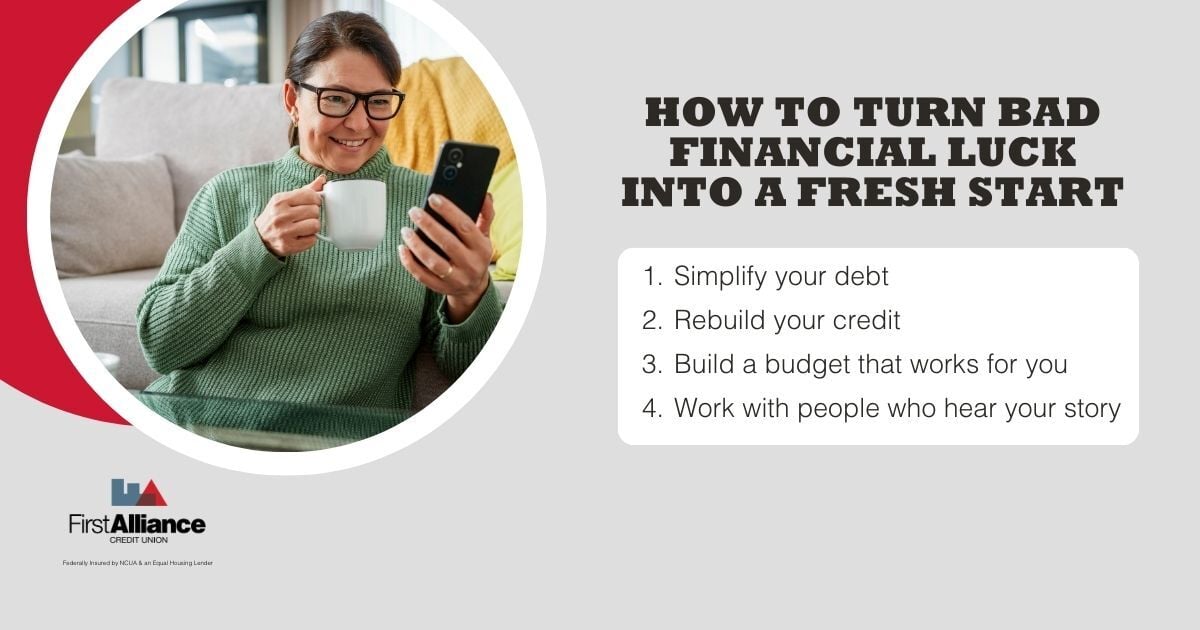
One of the most exhausting parts of financial hardship is keeping up with multiple payments, each with its own due date, interest rate, and balance. It can feel overwhelming just trying to track it all, let alone pay it down.
That's where a debt consolidation loan can make a real difference. Instead of managing several separate payments, you combine them into one single monthly payment at a lower interest rate. For many people, this means a lower total monthly payment, a simpler budget, and a much clearer finish line.
At First Alliance, we take the time to understand what you're working with and what you're working toward. Our Member Advisors look at your full picture, not just a number on a screen, and they help find options that genuinely fit your life.
If high-interest debt has been eating away at your budget, this is often the first step that gives people real, tangible relief. It won't happen overnight, but it can absolutely change your financial direction.
A question we hear often is this: "Can I really rebuild my credit after everything that's happened?"
Yes. Absolutely, yes. It takes some patience and the right tools, but it is very much within reach. Here are a few approaches that work well:
Credit Builder Loans: You make small monthly payments into a savings account, and those on-time payments get reported to the credit bureaus. By the end of the term, you've strengthened your credit history and built up savings at the same time.
Secured Credit Cards: You deposit a small amount as collateral, which becomes your credit limit. Use it for everyday purchases, pay it off each month, and you're steadily building positive credit history in a low-risk, manageable way.
Check Your Credit Report: You're entitled to a free credit report each year from each of the three major bureaus. It's worth pulling them to look for errors. Mistakes happen more often than people expect, and getting them corrected can be one of the fastest ways to see your score improve.
None of these are instant fixes, but they work. And every single on-time payment is progress. Over time, those payments add up to something real.
A lot of the financial advice you see out there is written for people who are already in a comfortable place. It can feel out of touch when you're simply trying to keep your head above water.
Budgeting after hardship looks a little different. It means starting with what you actually have today. It means being gentle with yourself when the numbers are tight. And it means building a plan that takes care of the basics first, makes space to chip away at debt, and finds room to save even a small amount along the way.
Even $20 a month set aside is meaningful. It's the beginning of an emergency fund. It's a foundation. It's proof to yourself that you are moving forward. Over time, small steps really do add up to big changes.
Our Member Advisors can sit with you, go over your income and expenses, and help you map out a simple, realistic plan. No finance degree required, and no judgment at the table.
This is where First Alliance genuinely stands apart.
We use human-centered underwriting for many of our lending decisions. That means a real person reviews your application, your circumstances, and your story, rather than leaving the decision entirely to an automated system based on a three-digit number.
If you’ve struggled to get approved for financial products in the past, it’s important to know that your story isn’t defined by a single decision. Credit unions operate a little differently. Because we’re member-owned, our focus is on helping people succeed financially and supporting the communities we serve. When our members grow stronger financially, the whole community benefits.
Scheduling a Member Advisor appointment is completely free and there's no obligation. It's simply a conversation with someone who is genuinely on your side and wants to help you figure out what's possible.
We want to be honest with you: rebuilding takes time. It asks for consistency and patience, and there will be moments when progress feels slow. That's normal, and it doesn't mean you're doing anything wrong.
What we've seen, time and time again, is that people who felt completely stuck, who came in not knowing if there was any way forward, went on to reach goals they once thought were out of reach. Paying off medical debt. Building up savings. Buying a first home. Getting to a place where money finally feels manageable.
The turning point is almost never luck. It's the decision to take one step forward, and then another.
You can do this. And you don't have to do it alone.
Here are a few simple ways to begin rebuilding today. Even one small step can make a difference:
Schedule a conversation with a member advisor: Talking through your situation with someone you trust can help you see your options more clearly.
Look into debt consolidation options: Combining multiple debts into one payment may help simplify your finances and reduce stress.
Consider tools that help build credit: Options like credit builder loans or secured credit cards can help you rebuild your credit history over time.
Review your credit report: Checking your report can help you spot errors and better understand your current financial standing.
Learn from trusted financial resources: Podcasts, blogs, and financial education programs can provide helpful tips as you rebuild.
You don’t have to have everything figured out before taking the first step. What matters most is starting where you are. This Patrick’s Day, forget about finding a four-leaf clover. Your fresh start begins with one small, brave step forward.

 Chris Gottschalk : Dec 26, 2023, 4:45:00 AM
Discover the 5 essential steps to financial literacy for beginners and youth financial literacy. Gain financial independence with our expert advice.

 Jenna Taubel : Apr 18, 2024, 2:59:25 PM
How to help your kids secure a strong financial future? Teach your kids money management early on for lifelong financial well-being with these quick...
 Chris Gottschalk : Aug 16, 2022, 4:45:00 AM
Financial stress can affect everyone, but you can take steps to alleviate it. Here are 4 effective ways to reduce financial stress.