
For those new to online banking: click here to get started.
 Allethea Faye Monfiel

Opening your first credit card statement can leave you wondering which numbers matter and what you're supposed to pay. You don't have to figure it all out at once. Your statement shows what you owe, when your payment is due and the purchases you've made during the period it covers, called the billing cycle.
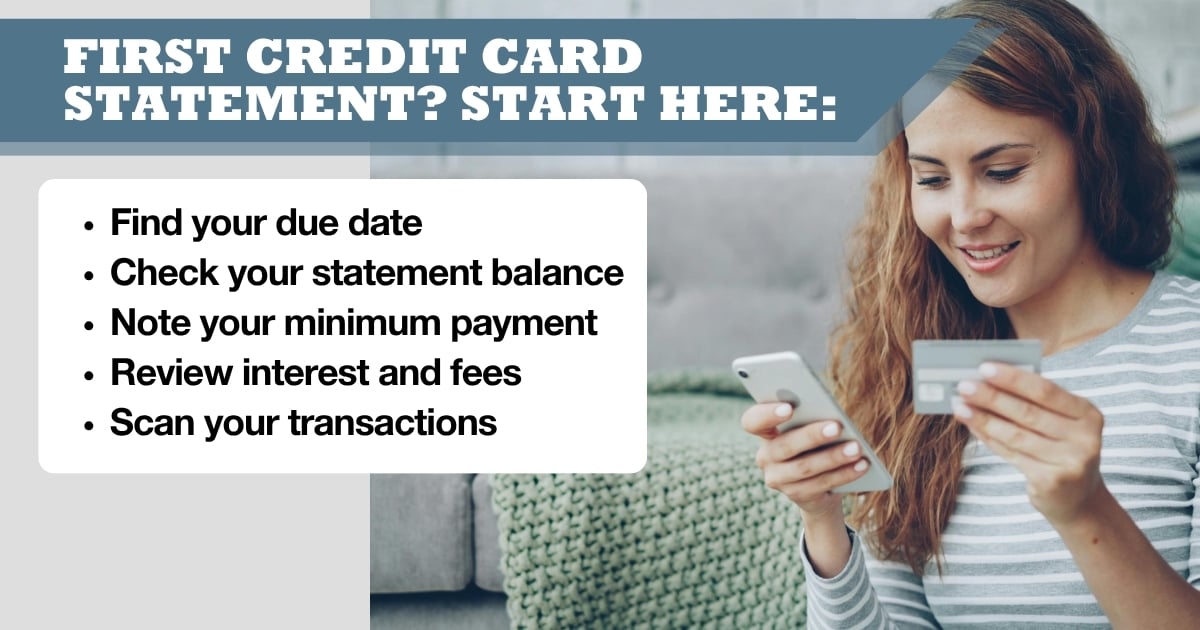
Start with three details: your payment due date, statement balance, and minimum payment. Then review your transactions, fees, and interest to understand how your balance adds up and plan your next payment.
What Should I Look at First on My Credit Card Statement?
Look for the payment summary, usually near the top of the first page. It brings three key details together so you don't have to search through every charge to figure out your next payment.
Let's say your credit card statement lists a balance of $412.60, a minimum payment of $25 and a due date of October 31. Here's what those details mean:
-
Your statement balance of $412.60 is what you owed when the billing cycle ended.
-
Your minimum payment of $25 is the least you need to pay by the due date to keep your account current. Paying only this amount leaves a balance, and interest may apply.
-
Your payment due date of October 31 is when your payment needs to arrive, so allow time for it to be processed.
Finding these details is a practical first step: you know what you owe, the least you need to pay and when it's due. From there, you can review your purchases and any fees or interest to see how the balance adds up.
Your Credit Card Statement Explained With a Sample
Your credit card statement may look a little different depending on who issued your card, but the key details are usually the same. Let's use a simple, made-up example to see how the numbers fit together. You can follow along with your own statement, one detail at a time.
Hypothetical Credit Card Statement
| Statement detail | Sample amount or date |
|---|---|
| Billing cycle | September 6 to October 5 |
| Previous balance | $0.00 |
| New purchases | $412.60 |
| Fees charged | $0.00 |
| Interest charged | $0.00 |
| Statement balance | $412.60 |
| Minimum payment due | $25.00 |
| Payment due date | October 31 |
| Purchase APR | 18.00% |
| Credit limit | $1,000.00 |
In this example, you started with no balance and made $412.60 in purchases during the billing cycle. With no fees or interest added, your statement balance comes to $412.60—the same amount you spent.
Let's take each part one at a time so you know what to look for on your own statement and how it helps you plan your payment.
Billing Cycle
Your billing cycle is the stretch of time your statement covers, usually about a month. The exact dates depend on your account. In our example, it runs from September 6 through October 5, rather than following a calendar month.
If a recent purchase isn't listed, check when it posted—that's when it was added to your account, which may be later than the day you bought something. Purchases that post after the cycle closes generally appear on your next statement. Knowing that cutoff can help you see why a charge shows up one month instead of another.
Statement Balance
Your statement balance is the amount you owed when the billing cycle ended. It includes the activity reflected on that statement, such as purchases, payments, credits, fees and interest.
In our example, the statement balance is $412.60. This is an important number to know because paying your full statement balance by the due date is generally the best way to avoid interest on purchases when your card offers a grace period and you qualify for it.
Current Balance
Your current balance reflects the activity that has posted to your account since the last statement, along with any other balance still owed. It can change whenever a purchase, payment or credit posts.
For example, if your statement balance is $412.60 and you make another $40 purchase after the billing cycle closes, your current balance could rise to $452.60, assuming no other activity. The two balances don't necessarily match because they reflect different points in time.
Minimum Payment
Your minimum payment is the least you need to pay by the due date to keep your account current. You'll find it in the payment summary. In our example, that's $25.
If your budget is tight this month, paying at least the minimum on time is an important step. Just keep in mind that it doesn't pay off the full balance. Interest may apply to what you still owe, making the balance cost more and take longer to repay. When your budget allows, paying more than the minimum can help you make faster progress.
Annual Percentage Rate (APR)
Your annual percentage rate, or APR, is the yearly rate used to calculate interest on certain balances. Your card may have different APRs for purchases, balance transfers and cash advances.
The sample statement lists a purchase APR of 18%. That doesn't mean the cardholder automatically owes 18% of the statement balance in interest. Whether interest applies, and how much is charged, depends on the card's terms, payment history and applicable grace period.
Fees and Interest Charges
Fees and interest can help explain why your balance is higher than the amount you spent. These sections show costs added beyond your purchases, such as interest, late payment fees or foreign transaction fees, depending on your card's terms and how you use it.
Our sample shows $0 in both sections. If your own statement lists a charge, start with its description and amount. If you're still unsure why it's there, ask your card issuer to explain it. You don't have to guess what you're paying for.
Transactions
Your transaction list breaks down the activity behind your balance: purchases, payments, credits and other items recorded during the billing cycle. Each entry usually shows a date, a business name or description and an amount, so you can check it against your receipts.
Set aside a few minutes each month to look through the entries. If a business name doesn't sound familiar, compare the date and amount with your recent purchases or email receipts. Some businesses use a different name on your statement, so an unfamiliar entry doesn't automatically mean something is wrong. If you still can't identify a charge, contact your card issuer promptly.
What Is the Difference Between My Statement Balance and Current Balance?
Seeing two different balances can make it hard to know what you actually need to pay. Your statement balance is a snapshot of what you owed when the billing cycle closed. Your current balance starts with that amount and reflects payments, purchases and other activity posted since then.
Let's say your statement balance is $412.60. After the cycle closes, you make a $40 purchase and pay $100 toward your card. Once both transactions post, your current balance is $352.60, assuming no other activity. Your original statement still shows $412.60 because it records an earlier point in time.
When planning your payment, check how much of your statement balance remains unpaid. In this simple example, your $100 payment leaves $312.60 of that balance to pay; the new $40 purchase belongs to the next billing cycle. Paying the remaining statement balance by the due date generally helps you avoid interest on purchases if your card offers a grace period and you qualify for it. Check your card's terms if you're unsure.
Should I Pay More Than the Minimum Payment?
The minimum payment is the amount required to keep your account current, but paying more can help you reduce your balance faster and limit interest costs.
When you pay only the minimum, a larger portion of your future payments may go toward interest rather than reducing the amount you originally borrowed. The remaining balance can also continue to accrue interest, depending on your card's terms.
If you can afford it, paying the full statement balance by the due date is generally the better option for avoiding interest on purchases. If that isn't realistic this month, pay at least the minimum on time and put additional money toward the balance when your budget allows.
How fast could you pay off your balance?
See how paying more than the minimum saves you time and interest.

How Much Should I Pay by the Due Date?
Whenever possible, pay your full statement balance by the due date. For eligible purchases, this generally helps you avoid interest when you have a grace period and meet the terms required to keep it.
With a First Alliance credit card, your due date is at least 25 days after your billing cycle closes. You can generally avoid interest on purchases by paying your full balance by the due date each month, subject to your cardholder agreement. If you carry a balance into the next month, interest may apply.
But If you can't pay the full balance, make at least the minimum payment on time to help keep your account in good standing. Then, pay as much extra as your budget allows. Our guide on how to pay off credit card debt offers practical strategies for working toward a lower balance.
Where Can I Find My Payment Due Date, Interest Charges and Fees?
Your payment due date, statement balance and minimum payment are usually grouped near the top of your statement. Interest charges and fees typically appear in separate sections, while your transactions are listed elsewhere.
When reviewing your statement each month, pay attention to these five things:
- Payment due date: When your payment needs to arrive.
- Statement balance: What you owed when the billing cycle closed.
- Minimum payment: The least you must pay to keep the account current.
- Interest and fees: Additional charges applied to your account.
- Transactions: Purchases, payments and credits recorded during the billing cycle.
Checking these details regularly helps you catch unexpected charges, understand changes in your balance and plan your next payment. Once you’ve reviewed a statement, our guide on how long to keep credit card statements can help you decide which records to save and which ones you can safely shred.
What Should I Do If I See a Charge I Don't Recognize?
An unfamiliar transaction doesn't always mean your card has been compromised. Some businesses process payments under a parent company or a name you don't immediately recognize. You might also see a subscription renewal or a purchase that someone else authorized to use the card made.
Start by checking the transaction date and amount against your receipts, emails and recent purchases. If another authorized user shares the account, ask whether they recognize the charge.
If you still can't identify it, contact your card issuer promptly rather than waiting for your next statement. First Alliance credit cardholders can call 844-252-0674 to reach customer service or dispute a charge.
A few minutes spent checking your transactions can help you catch unfamiliar charges sooner and ask for help before another statement arrives.
Tools That Help You Stay on Top of Your Card Between Statements
You don't have to wait for your monthly statement to check your balance or review your spending. First Alliance offers online and mobile banking tools that help you keep track of your account between billing cycles.
-
Online and Mobile Banking: Check your credit card balance, review recent transactions, set up account alerts, pay your credit card from your First Alliance checking or savings account, and view monthly statements through Online Banking.
-
My Cards: Manage how, when, and where compatible cards are used through the mobile app.
-
My Money Budgeting Tool: View your accounts in one place and see how your credit card balance fits into your overall budget, helping you plan for your next payment.
Using these tools between billing cycles can help you stay aware of your spending, track upcoming payments, and spot unfamiliar transactions sooner. Combined with a monthly statement review, they make it easier to manage your credit card and keep your payments on track.
Contact Us and let our team help you feel more comfortable managing your credit card!

Feel More Confident Managing Your Credit Card with First Alliance Credit Union
Understanding your credit card statement is a great first step toward managing your money with confidence. By checking your balance, keeping track of your due date, and reviewing your transactions each month, you can stay on top of your payments and feel more in control of your spending.
Have more questions about managing your money? Tune in to Good Money Moves Podcast, Episode 44, "Beginners Guide for Credit Card" for more helpful insights and practical tips to build your financial confidence. It's another great way to keep learning and feel more comfortable making decisions about your money.
Watch Here!