For those new to online banking: click here to get started.
Ever look at your checking account and wonder if you are keeping too much money there – or not enough? You want to have enough to cover your bills and everyday expenses, but you also do not want money sitting in checking when it could be helping you reach your savings goals.
The good news is that you do not need to guess. Your ideal checking balance comes down to what bills you have coming up, how you spend your money, when you get paid, and how much of a cushion gives you peace of mind.
In this guide, we will walk through a simple way to find the right checking balance for your budget, avoid unnecessary overdrafts, and know when it may make sense to move extra money into savings.
How Much Money Should You Keep in Your Checking Account?
A checking account (sometimes called a debit account) is designed for everyday money management. It is typically where you keep money for regular expenses, pay bills, make purchases, and access funds when you need them. Because your checking account is meant for frequent spending, the goal is to keep enough available to cover your upcoming while maintaining a comfortable buffer in case something extra hits your account unexpectedly.
A good checking account balance generally covers two things: your upcoming expenses and personal cushion.
Upcoming expenses include bills and everyday spending you know you will need to pay, such as:
- Rent or mortgage
- Utilities
- Groceries/food
- Car payments
- Insurance
- Loan payments
- Subscriptions and memberships
Your cushion is extra money you keep in checking in case a bill is higher than expected or an unexpected expense comes up before your next paycheck. For most people, this is a small buffer between 10% and 20% of your regular expenses.
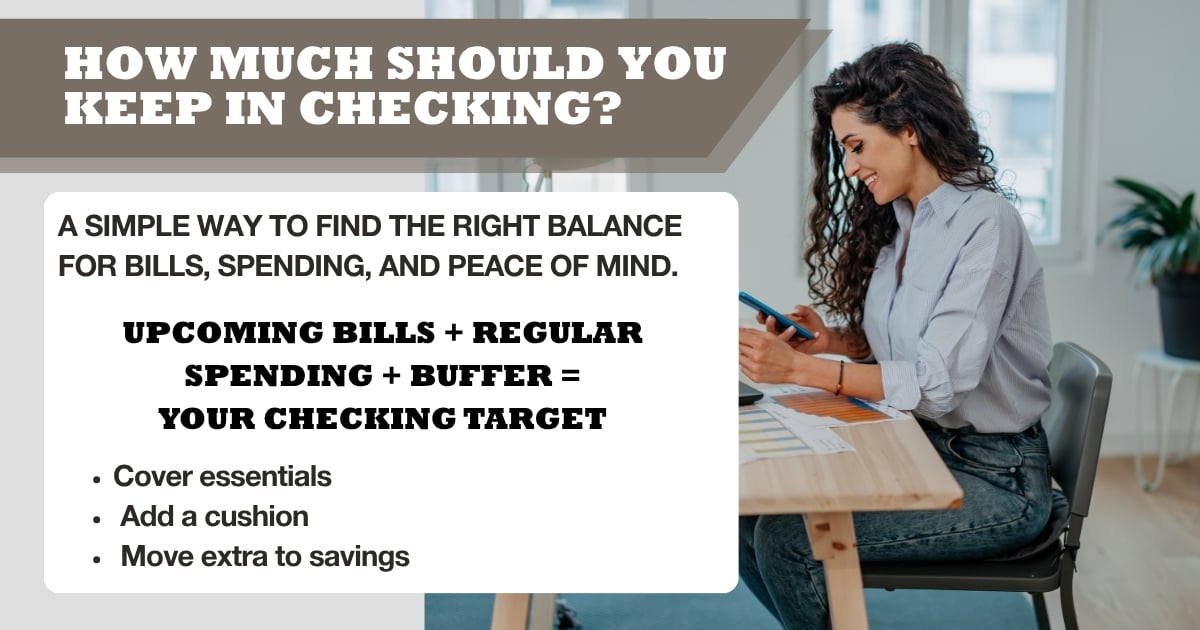
A simple way to calculate your target balance is:
Upcoming bills and regular spending + personal cushion = checking account target
For example, if your upcoming bills and regular spending add up to $2,000, a 15% cushion would add $300. That gives you a checking account target of $2,300, helping you cover expected expenses while keeping a little extra breathing room between paychecks.
Your ideal balance may look different from someone else's. If you receive a steady paycheck every week or every two weeks, you may be comfortable with a smaller cushion. If your income varies or you get paid less frequently, keeping more in checking may give you extra breathing room.
What Is a Checking Account Buffer?
A checking account buffer is the extra money you keep beyond what you expect to spend. It gives you some flexibility when your actual expenses do not go exactly according to plan.
For example, your electric bill might be higher than usual, you might need to fill up your gas tank more often, or an unexpected expense could come up before payday. A buffer can help cover these costs without putting your account at risk of overdrawing.
There is no required amount for a checking buffer. Some people may feel comfortable with $100 or $200, while others may prefer $500 or more.
Consider these questions when deciding how much to keep in your checking account:
-
How often do you get paid?
-
Is your income predictable?
-
Do your monthly bills stay about the same?
-
How closely do you track your spending?
-
Have you come close to overdrawing your account in the past?
The goal is to keep enough in checking to give yourself some flexibility without leaving extra money there that could be supporting your other financial goals.
If you want a clear picture of your spending, the First Alliance Credit Union My Money tool, built into Online & Mobile Banking, can help you view your accounts, categorize transactions, and see your typical spending patters. This can make it easier to choose a checking buffer that fits your budget.
Plus, Checking Accounts from First Alliance Credit Union also offer overdraft protection options, including Courtesy Pay and the ability to link a savings account for automatic transfers when checking funds are low. These options are not a substitute for maintaining a checking buffer, but they can provide an extra layer of protection when an unexpected expense comes up.

How Do You Calculate How Much to Keep in Checking for Monthly Bills
If you are trying to figure out how much you need in checking each month, start by looking at what typically comes out of your account. The goal is to keep enough money available to cover your regular bills and everyday expenses without leaving more cash in checking than you need.
Make a list of your regular expenses, including:
-
Rent or mortgage
-
Electricity, water, gas, and internet
-
Insurance premiums
-
Car payments and fuel
-
Groceries and household essentials
-
Loan payments
-
Credit card payments
-
Subscriptions and memberships
-
Other recurring payments
Add these expenses together to get your baseline monthly spending. Then add the checking buffer you are comfortable with, most people plan for 10-20% over their regular spending.
For example, at 15% buffer could look like this:
$2,000 in monthly expenses + $300 buffer = $2,300 checking target
It can also help to look at when your bills are due. You may have enough money to cover all your expenses for the month but still run short temporarily if several large payments come out at the same time. Mapping out your bill due dates can help you make sure the money is in your account when you need it.
Want a clearer picture of where your money goes each month? Use our Cash Flow Budget Worksheet to organize your income, expenses, and bill due dates so you can set a checking balance that works for you.
How Much Should You Keep in Checking vs Savings?
Once you know how much you need in checking, you may be wondering what to do with the money you do not need right away. A simple rule is to use checking for near-term spending and savings for money you plan to set aside. For example:
-
Keep in Checking: Money you need for upcoming bills, groceries, and everyday purchases
-
Keep in Savings: Money you are setting aside for emergencies, larger purchases, or future goals
Keeping more money in checking than you need for your upcoming expenses and buffer is not necessarily a problem. But if you have extra funds sitting there with no specific purpose, moving some of that money into savings can help you make better use of it.
For larger savings balances that you still want to keep accessible while earning dividends, a Money Market Savings Account may be worth considering. Personal Money Market accounts open with a $2,000 minimum deposits and offer tiered dividend rates.
The important thing is to give your money a purpose. Keep enough in checking to comfortably manage your day-to-day finances, then consider putting the rest toward your savings goals.
Should You Keep One Month of Expenses in Checking?
Keeping one month of expenses in checking can be helpful, but you do not necessarily need that much. The right amount depends on when you get paid, when your bills are due, and how predictable your monthly expenses are.
If you get paid regularly and your bills are consistent, you may be comfortable keeping less in checking and moving extra money to savings. If you often find yourself running low before your next paycheck, keeping a little more in checking could give you more breathing room.
A good starting point is to keep enough for your upcoming bills and regular spending, plus a small buffer for unexpected expenses. If you consistently have much more than that sitting in checking, you can consider moving some of it to savings.
How Often Should You Review Your Checking Balance?
It’s a good idea to check your checking account regularly, especially when your income or expenses change. A new job, higher bills, or a new monthly payment can all affect how much you need to keep in your account.
Once a month, take a few minutes to look at:
-
Money that came in
-
Bills and other payments
-
Everyday spending
-
Whether you used your checking buffer
-
How much money was left at the end of the month
If you regularly have more money in checking than you need, you could move some to savings. If you keep running low before your next paycheck, you may need to increase your checking balance or adjust your budget.
You can make this monthly check easier with First Alliance Credit Union’s Mobile Banking app. A quick look at your balance, recent transactions, and upcoming payments can help you stay on track and spot changes in your spending.
A Simple Way to Find the Right Checking Account Balance
You do not need a complicated formula to figure out how much money to keep in checking. Start with these four steps:
1. Adding Up Your Upcoming Bills and Regular Spending
Start by adding up the expenses you expect to pay, including rent or mortgage, utilities, groceries, transportation, insurance, loan payments, subscriptions, and other regular purchases. This gives you a baseline for how much you need in checking to cover your normal monthly spending.
2. Choose a Checking Buffer That Gives You Breathing Room
Add a little extra to your baseline to create a checking buffer. This gives you some flexibility if a bill is higher than expected or an unexpected expense comes up before your next paycheck. Your buffer might be $100, $300, $500, or more depending on your income, expenses, and comfort level.
3. Keep Your Target Amount Available in Checking
Add your regular expenses and checking buffer together to determine your target balance. For example, if your monthly expenses are $2,000 and you want a $300 cushion, keeping about $2,300 in checking can help you stay prepared for upcoming payments while reducing the risk of overdrawing your account.
4. Move Extra Money Toward Your Financial Goals
If you consistently have more in checking than you need for upcoming expenses and your buffer, consider moving some of the extra savings. This can help you build an emergency fund, save for a larger purchase, or work toward another financial goal while keeping enough money in checking for your everyday needs.
For example, if you expect to spend $2,000 over the next month and want a $300 buffer, your checking target would be around $2,300. Review that number regularly and adjust it as your income, expenses, and goals change.
Frequently Asked Questions
You can, but you do not necessarily need to. Some people prefer keeping one month of expenses in checking for convenience, while others keep a smaller balance and move extra money into savings. The right approach is the one that lets you comfortably cover your bills and maintain a buffer.
Keep enough in checking to cover your upcoming bills, regular spending, and a personal buffer. Money you do not expect to need in the near term can generally be moved into savings or another account that fits your goals.
There is no one-size-fits-all amount. A buffer of $100 to $500 may be enough for some people, while others may want more. Consider your income schedule, spending habits, and typical monthly expenses when choosing your buffer.
Once your upcoming bills, regular spending, and checking buffer are covered, you can consider moving extra money into a Savings Account. This can help separate money you need for everyday expenses from money you are saving for emergencies or future goals.
Let First Alliance Credit Union Help You Find the Right Balance
Finding the right checking account balance does not have to be complicated. Start with what you know you will need, add a cushion that makes you comfortable, and revisit your numbers as your financial situation changes.
If you would like to help reviewing your accounts, setting up a savings plan, or choosing the right account for your goals our team at First Alliance Credit Union is here to help!