
How To Choose a Credit Card
 Jenna Taubel : Jul 23, 2019, 7:00:00 AM
Credit cards are a big responsibility. Know how to choose a credit card, and you can avoid a lot of financial troubles.
6 min read

Most people know credit card interest exists. What trips people up is the part nobody explains clearly: when exactly it kicks in, how it quietly compounds in the background, and what it actually takes to avoid paying it. If you have ever looked at a statement and wondered why your balance barely moved despite making payments, this post is for you. We are going to break it all down in this post so you can use your card with confidence and keep more of your money where it belongs.
Credit card interest is the fee a lender charges when you borrow money and do not pay it back within the billing cycle. It is expressed as an APR, or annual percentage rate, which is the yearly cost of borrowing on a credit card shown as a percentage.
So if your card has a 15% APR, that does not mean you are charged 15% every month. Your APR gets broken down into a daily periodic rate, which is your APR divided by 365 days. That daily rate is then applied to your outstanding balance for each day it remains unpaid.
Say you carry a $1,000 balance at 15% APR. Your daily rate is roughly 0.041%. After 30 days of carrying that balance, you would owe about $12 to $13 in interest. That amount compounds if you continue carrying a balance month over month, which is how a manageable balance can slowly grow larger than expected.
This is one of the most common questions people have, and the answer often surprises them: credit cards do not always charge interest right away.
Most credit cards come with a grace period. A grace period on a credit card is the window of time between the end of your billing cycle and your payment due date. During this window, if you pay your full statement balance, no interest is charged on purchases.
Here is when credit card interest does get charged:
If you do not pay the full statement balance by the due date, interest begins accruing on the remaining amount.
Minimum payments keep your account current, but they leave most of your balance sitting there collecting interest every day.
Cash advances are not covered by the grace period. Interest starts accruing from the transaction date, at the same rate as purchases.
If you have an existing balance, new purchases may start accruing interest right away instead of benefiting from the grace period.
Knowing when interest is and is not triggered helps you make decisions that keep costs from creeping up when your managing your credit card.
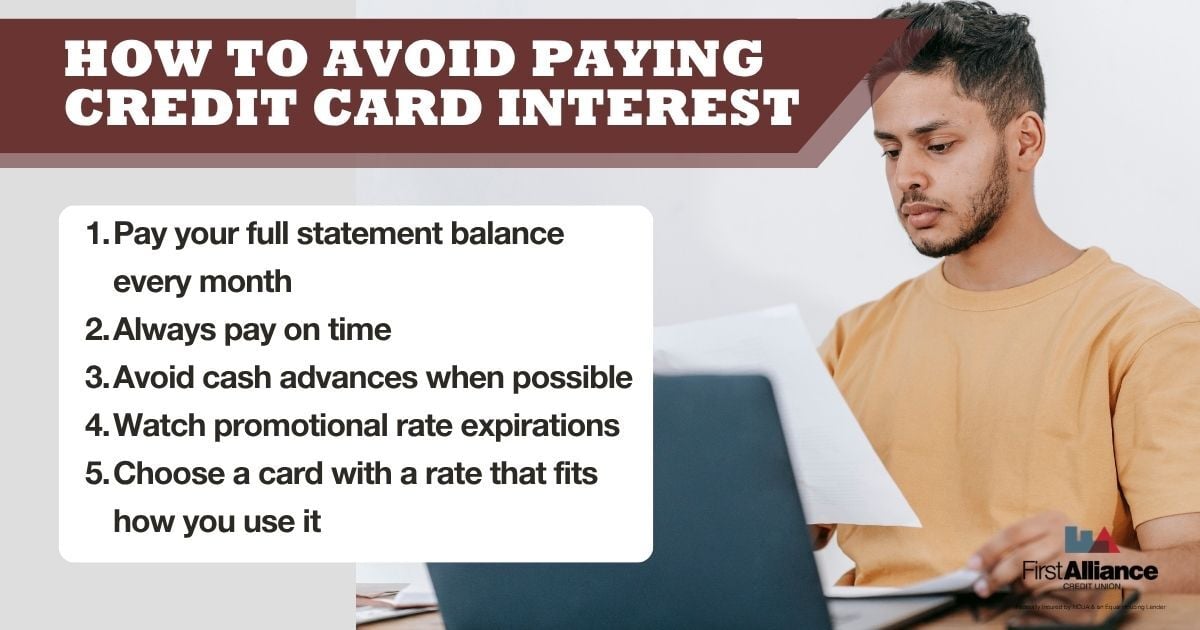
The good news is that avoiding credit card interest is genuinely possible. Here are the 5 steps that actually work:
This is the single most effective habit you can build. When you pay the full statement balance by your due date, you keep your grace period intact and owe zero in interest. It does not matter how much you charged that month. Paying it all off resets the clock.
A late payment does not just result in a late fee. It can also eliminate your grace period, which means new purchases start accruing interest immediately. Setting up autopay for at least the minimum payment protects you from accidental slip-ups, and paying more than the minimum whenever possible keeps your balance moving in the right direction.
Because there is no grace period and interest starts right away, cash advances can get expensive quickly. If you need short-term cash, a personal loan from First Alliance Credit Union is often a smarter and more affordable option.
Some credit cards offer a 0% introductory APR for a set period. If you carry a balance past that end date, interest kicks in based on your regular rate. Mark the expiration on your calendar and plan to pay down the balance before it arrives.
If you tend to carry a balance occasionally, a lower APR will save you real money. First Alliance offers three Mastercard credit card options with no annual fees, so there is likely one that fits where you are financially right now.
It is worth spelling this out, because many cardholders do not realize how costly minimum payments can be over time.
Minimum payments are typically calculated as a small percentage of your balance or a flat dollar amount, whichever is higher. They keep your account current, but they are designed to stretch your repayment over a long period.
Using a $1,000 balance as an example: if your minimum payment is around $25 to $30 per month, it can take years to fully pay off the balance. During that time, interest compounds on whatever remains unpaid. The total amount you end up paying is significantly more than the original $1,000 you spent.
Paying even a little more than the minimum each month makes a meaningful difference. And paying the full statement balance? That is how you avoid paying interest on purchases at all.

Not all credit cards work the same way, and choosing one that fits your spending habits can save you money without requiring much effort.
Earn points on every purchase you make online and in stores, and redeem them for rewards like cash back, travel, and more. This card works best if you tend to pay your balance in full each month and want to earn something back on everyday spending. No annual fees and no foreign transaction fees.
Built for members who want simplicity and predictability. No annual fee and no fees for balance transfers or cash advances. If you sometimes carry a balance and want to keep interest costs as low as possible, this is worth a close look.
Designed for members who are working to build or rebuild their credit. No annual fees and no fees for balance transfers or cash advances. It is a practical place to start if you are earlier in your credit journey and want a card that gives you room to grow.
And if you are focused on building credit responsibly without taking on revolving debt, a Credit Builder Loan from First Alliance Credit Union is another tool worth knowing about. It helps you establish a positive payment history in a low-risk, structured way.

These are the questions we hear most often from members who want to get a better handle on how credit card interest works.
Interest is calculated using a daily periodic rate, which is your APR divided by 365. That rate is applied to your average daily balance for the billing cycle. The longer a balance remains unpaid and the higher your APR, the more interest you will owe over time.
The grace period is the time between the end of your billing cycle and your payment due date. If you pay your full statement balance before the due date, interest is not charged on purchases made during that billing cycle. If you carry any balance forward, the grace period no longer applies to new purchases until the balance is paid in full.
Yes. Paying your full statement balance by the due date every month is how you avoid credit card interest entirely. As long as you do not carry a balance, no interest is charged on purchases.
Yes. When you pay less than the full statement balance, the remaining amount carries forward and begins accruing interest. The minimum payment keeps your account in good standing, but it does not stop interest from accumulating on the unpaid portion.
In many cases, yes. When you have an existing balance, new purchases may lose the grace period and start accruing interest right away. Paying your balance in full each month is the most reliable way to preserve the grace period on new purchases.
The Platinum Card has a lowest APR and is a good fit for members who may carry a balance occasionally. The Classic Card is designed for members who are building or rebuilding their credit. Both have no annual fees. The right choice depends on where you are in your credit journey.
Credit card interest is not inevitable. Once you understand how it is calculated, when it applies, and what habits keep it from building up, you are in a much stronger position to use credit confidently.
The practical summary is this: pay your full statement balance on time, avoid cash advances when you have other options, and choose a card whose rate and benefits works for how you actually use it. Those three things alone can save you a meaningful amount of money over the long run.
If you want to explore your credit card options at First Alliance or just want to talk through what makes sense for your situation, we are here for it. Take a look at our credit card options or reach out to our team with any questions.

 Jenna Taubel : Jul 23, 2019, 7:00:00 AM
Credit cards are a big responsibility. Know how to choose a credit card, and you can avoid a lot of financial troubles.

 First Alliance Credit Union : Dec 12, 2019, 7:31:00 AM
When you know how to use a credit card wisely, you'll be able to improve your personal finances. Learn how to use credit cards wisely with a few...
 First Alliance Credit Union : May 19, 2020, 6:14:00 AM
If you use a credit card properly, it can be a great relationship. So here's a few tips to for how to make your credit card your best friend.