
<img src="https://events.xg4ken.com/pixel/v2?tid=KT-N2BAB-3ED&amp;noscript=1" width="1" height="1" style="display:none">
Skip to the main content.

4 min read

The End of the Penny: What It Means for Your Finances

The End of the Penny: What It Means for Your Finances

The penny was first authorized in 1792, but as of November 12th, 2025 the United States has officially minted its final penny.

For decades, economists and lawmakers have debated whether keeping the one-cent coin made financial sense, especially as inflation rose and production costs climbed. Producing a penny has long cost more than one cent, which meant taxpayers were effectively paying millions every year just to keep a coin in circulation that buys less and less.

Now, with the last penny rolling off the presses, we’re entering a new era of monetary efficiency and more modern money management. While this is a big milestone historically, its impact on your everyday financial life will be more subtle, and in many ways, more convenient, especially as more of us rely on digital payments and streamlined banking tools.

Let’s break down what happens next.

Pennies Aren’t Disappearing Overnight

Even though new pennies won’t be made, the coins already in circulation will stick around for years. There are billions of them out there, and they won’t vanish just because production has stopped.

You’ll still find them in pockets, piggy banks, cash drawers, and the bottom of your car’s cupholder. Banks and credit unions will continue accepting them in deposits, and businesses can still use them to make change. Over time, as pennies become worn, damaged, or are turned in through deposits and coin-counting machines, the U.S. Mint will gradually pull them out of circulation instead of sending new ones back into the system.

So you don’t need to rush to turn them in or spend them immediately, pennies will slowly fade from everyday use, not disappear all at once.

The penny isn’t gone yet, the stock is just not being replenished.

Will Prices Change? Probably Not Much

One of the biggest questions people ask is: “If we don’t have pennies, how do we pay exact prices?”

For digital payments (debit cards, credit cards, mobile wallets) will continue to charge the exact amount down to the cent. Nothing changes there, your online purchases, automatic bill payments, and in-store card swipes will still process the precise total shown on your receipt, including sales tax and any fees.

In other words, if something costs $12.37, your account will be charged exactly $12.37, no rounding, no extra steps needed on your part.

For cash purchases however, time will tell, Congress and retailers may adopt rounding practices as penny supplies deplete. So, instead of counting out pennies, the final total would be rounded to the nearest five cents when you pay with physical cash, not when prices are set or when you pay with a card or mobile wallet.

In practice, that means your receipt subtotal would still show the exact amount, but the amount you hand over, bills and coins, would be slightly adjusted at the register. 

For example, a rounding system could look like this:

  • Total ending in 1¢ or 2¢ → round down
  • Total ending in 3¢ or 4¢ → round up
  • Totals at .05, .10, .15 stay the same

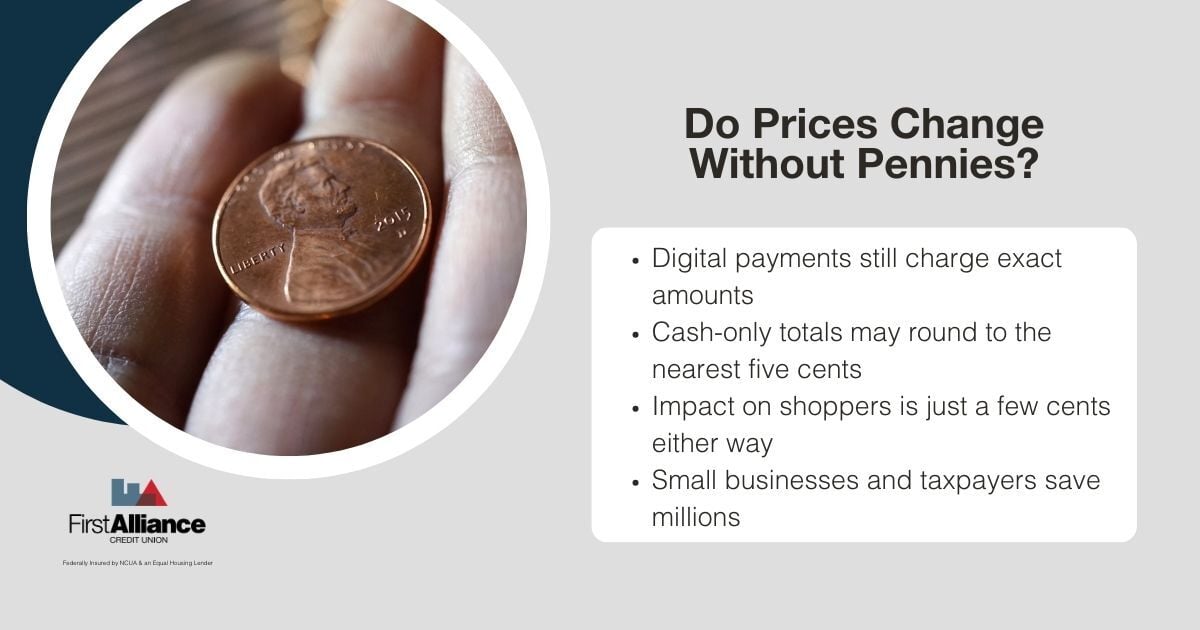
The overall impact on consumers is extremely small, just a few cents in either direction. And research from Canada and Australia (which stopped minting pennies years ago) shows that consumers don’t end up losing money in the long run.

do prices change without pennies

A Win for Small Businesses

If you’ve ever worked a cash register, you know pennies slow everything down, from the time it takes to count change to the extra steps in balancing the drawer at closing.

For retail workers, there will be no more:

  • Counting piles of pennies at the end of the night
  • Sorting and rolling pennies
  • Digging through penny trays to give exact change

For many small businesses, eliminating pennies could mean faster checkouts, fewer errors, and lower operating costs. That efficiency often benefits customers as well.

Taxpayer Savings Add Up

Even though each penny is worth one cent, it has cost more than two cents to produce in recent years, once you factor in the price of raw metals like copper and zinc, manufacturing, and distribution. In other words, the government has been spending more than double the coin’s face value just to make and move it, turning every new penny into a small but steady loss funded by taxpayers.

Stopping the production of pennies:

  • Saves taxpayers millions annually
  • Reduces waste and environmental impact
  • Allows the U.S. Mint to focus on higher-value coins

While it’s a small change in the grand scheme, it’s one that makes the entire currency system more efficient.

The Psychology of Prices Will Shift

The penny has long played an emotional role in retail pricing, signaling a “deal” or discount even when the savings are only one or two cents. For many shoppers, those familiar endings, like .99 or .97, have created a sense of getting more value for their money, even though the difference from the next whole dollar is minimal.

Think about how often you see pricing like this:

  • $4.98 instead of $5
  • $9.99 instead of $10
  • $14.97 instead of $15

These prices feel cheaper, because your brain reacts to the number on the left. But as fractional cents lose meaning in cash transactions, retailers may reevaluate the classic “.99 strategy.”

Overtime, we may see more round numbers as stores adjust to consumer expectations in a penny-less world.

A Small Change That Reflects a Bigger Shift

The discontinuation of the penny isn’t about the value of one cent, it’s about modernizing how we exchange money.

We’re already living in a highly digital financial world, where mobile payments and online shopping make exact change unnecessary. Phasing out the penny simply aligns our physical currency with how people actually pay today.

It’s not the end of value, it’s just the end of a symbol that no longer fits the way we live, shop, and manage our finances.

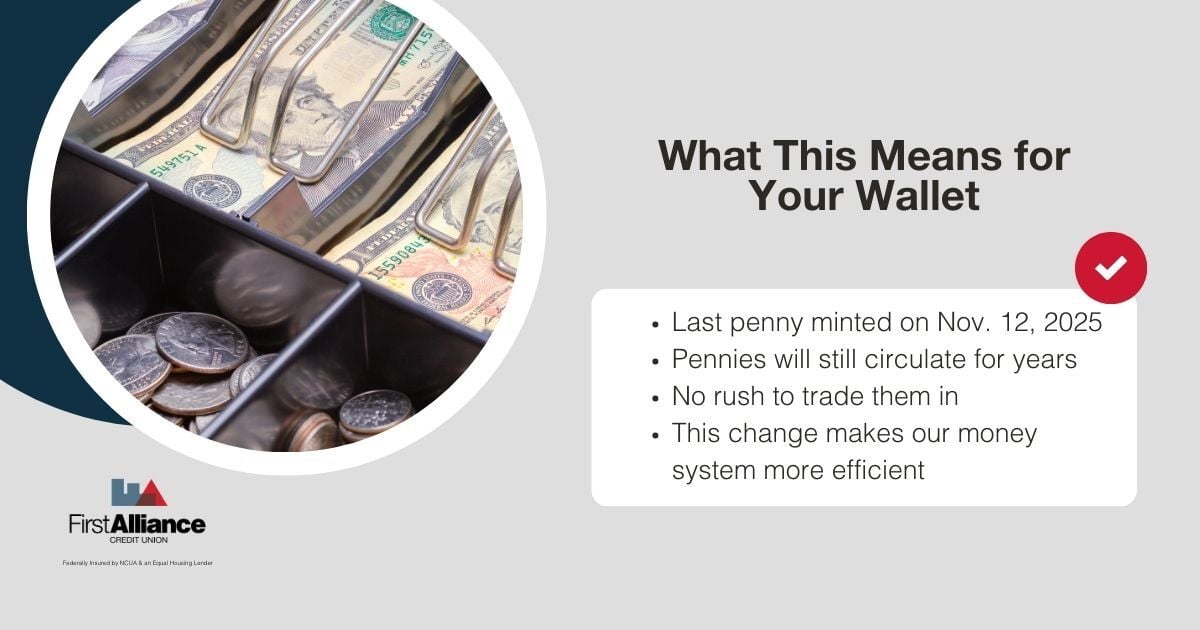
what this means for your wallet

Do I Have to Use Digital Payments Now?

The short answer is, no. Currency (including pennies) is still legal tender and will remain an acceptable form of payment as long as businesses choose to accept cash. You can keep using the coins and bills you already have for in-person purchases, paying friends back, or handling everyday transactions, just like you always have. 

However, if you’d like help adapting to a more digital, streamlined financial routine, or want to build better money habits as the world of payments evolves, our team at First Alliance Credit Union is here to help. From adding your debit or credit card to digital wallets to paying your friends with Zelle(R), our digital payment services are secure and easy to use.

Reach out anytime for personalized financial guidance.

How to Use Your First Alliance Cards With Digital Wallets

How to Use Your First Alliance Cards With Digital Wallets

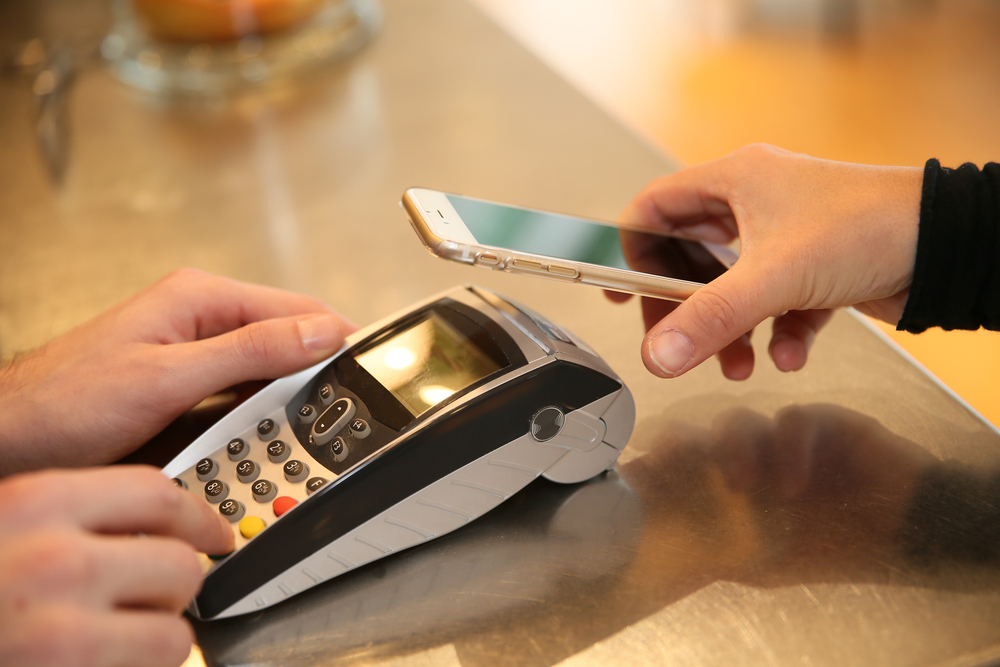
Mobile Wallets are convenient way to securely make purchases at stores, as well as online and through some apps. First Alliance Credit Union’s debit...
Read More
Digital Wallets for Beginners

Digital Wallets for Beginners

The way we use money is changing. Most people use credit cards and debit cards instead of actual dollars and cents when buying items or services, and...

Read More
Your Financial Security is a Top Priority at First Alliance

Your Financial Security is a Top Priority at First Alliance

With all of the recent data breaches and Facebook privacy concerns in the news the last few months, I felt it was important to highlight some of the...

Read More