
For those new to online banking: click here to get started.
 Allethea Faye Monfiel

When you share your life with someone, you naturally expect to be there for each other, especially when something unexpected happens. But when it comes to money, being married doesn't always mean your spouse can access your bank accounts or take care of your finances if you're unable to.
This is something many couples don't think about until a health issue or unexpected emergency comes up. Knowing who can access your accounts and what paperwork you may need can help you prepare ahead of time.
Can Your Spouse Access Your Bank Account If Something Happens to You?
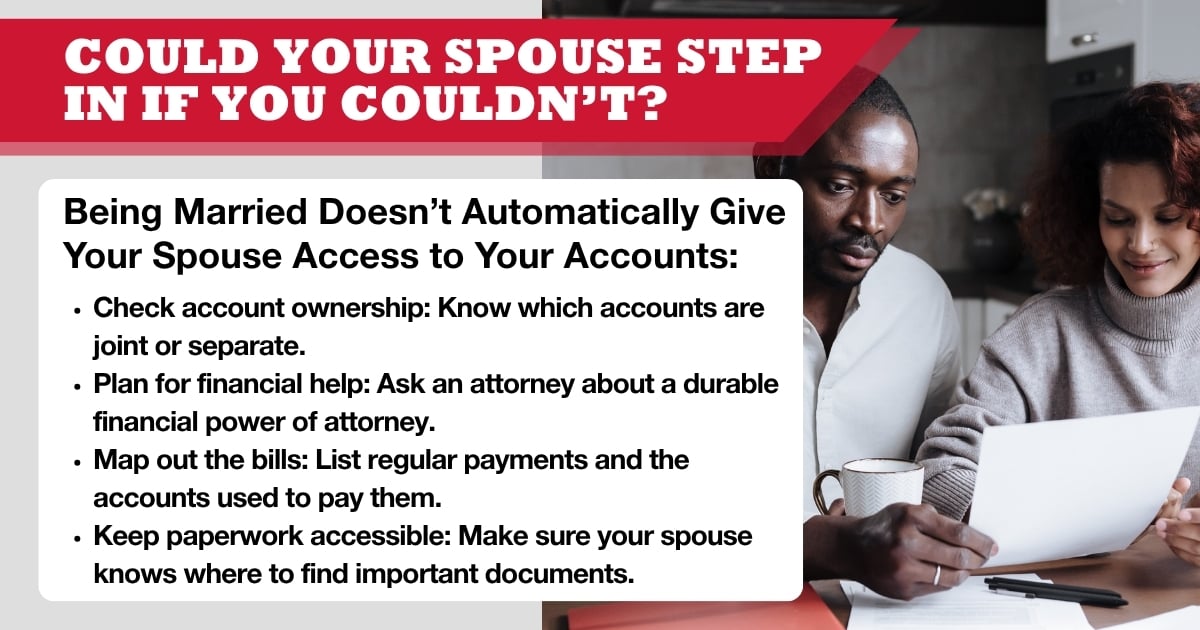
If your spouse isn't a joint owner on your account, they generally can't access or manage it just because you're married. They'll typically need legal authority, such as valid financial power of attorney, to act on your behalf.
It's understandable to assume your spouse could call the credit union, explain what's happened, and take care of things. However, financial institutions must verify account ownership and any legal authority before allowing someone to access another person's money.
There are ways to prepare for this. You can open a joint account for shared expenses or establish a financial power of attorney to give someone you trust the authority to handle certain financial matters. The right approach depends on your circumstances and how you'd like your finances to be managed.
Joint Account vs. Power of Attorney: What's the Difference?
A joint account and a financial power of attorney can both help your spouse manage financial matters, but they serve different purposes.
How a Joint Account Works
A joint account has two or more owners, and each owner generally has the right to access and withdraw money, subject to the account agreement. Many couples use joint checking accounts to manage shared expenses, such as the mortgage, groceries, and utility bills.
The main advantage is convenience. Since both spouses are account owners, either can generally access the money and take care of payments without additional authorization.
However, adding your spouse means making them a co-owner, not simply giving them permission to help in an emergency. Before opening a joint account, consider whether you're comfortable sharing ownership and the responsibilities that come with it.
How a Financial Power of Attorney Works
A financial power of attorney is a legal document that allows you to appoint someone, known as your agent, to handle certain financial matters on your behalf. Your agent doesn't become an owner of your money, and their authority depends on the document's terms and applicable state law.
In Minnesota, a power of attorney can be made durable by including the required language stating that the authority granted won't be affected by your incapacity. This can allow your agent to continue handling covered financial matters if you become unable to manage them yourself.
You may want your spouse to help with money matters in an emergency without making them a co-owner of every account. A durable financial power of attorney is one option to consider. An attorney can help you talk through what you'd want your spouse to handle and include the legal authority needed to reflect your wishes.
Can My Spouse Access My Account if I'm Incapacitated?
If you're unable to manage your finances because of an illness or accident, your spouse may be able to help if they're already a joint owner or have the appropriate legal authority, such as a valid durable financial power of attorney. Without either, your spouse may need to seek court approval to manage certain financial matters. Depending on the circumstances, this could involve a conservatorship, which can take time and add stress during an already difficult period.
It's also important to know that you generally need to have the legal capacity to create a power of attorney. If you become incapacitated before putting in one place, you may no longer be able to sign the document yourself. Planning ahead gives you the opportunity to choose someone you trust and make your wishes clear before an emergency occurs.
What Can Prevent Your Spouse From Accessing Your Accounts?
Even if you've discussed your finances together, a few things can make it harder for your spouse to step in when needed.
Your spouse may not be able to access an account if they're not listed as an owner and don't have the necessary legal authority. A power of attorney may also be insufficient if it doesn't grant the authority needed for the situation. And even when the document is valid, your spouse needs to know where to find it and how to provide it when requested.
Loans can be another source of confusion. Being a joint owner of your checking account doesn't automatically make your spouse a borrower on an auto loan or personal loan that's only in your name.
You might also consider sharing your online banking password so your spouse can log in if something happens. However, sharing credentials isn't a reliable substitute for authorized access and may create security or account-agreement issues. It's better to discuss appropriate access arrangements with your financial institution ahead of time.
You don't have to sort out every detail at once. Start by reviewing one account together: who can access it, what paperwork is in place, and where it's kept. That small step can help you see what to tackle next.
Can Your Spouse Pay Your Loans and Household Bills?
Your spouse may be able to help with some payments, but what they can do depends on the account, loan, and authorization involved.
For example, making a loan payment online may involve identity verification. However, accessing loan details or making changes to payment arrangements may require the person to be a borrower or have appropriate legal authority.
Household bills can present similar challenges. If your utilities or insurance premiums are paid from a checking account that's only in your name, your spouse may not be able to access the account or change payment details without authorization.
When you split the bills, it's easy for each of you to know your part without knowing the whole picture. Try making a list together of regular payments, such as your mortgage or rent, utilities, insurance, and loans, along with the accounts used to pay them. Then talk through how you'd keep those payments going if one of you couldn't manage them. This can help you spot where your spouse may need account access or additional legal authority.
Do You Need a Power of Attorney if Your Spouse Isn't on Your Account?
If you want your spouse to handle financial matters for you when you can't manage them yourself, a durable financial power of attorney is worth considering. This can be helpful even if you already share some accounts. You might have a joint checking account for household expenses but keep a separate savings account or have loans in your name alone. A power of attorney may allow your spouse to manage those other financial matters, depending on the authority granted in the document.
Sharing an account and giving someone permission to act for you aren't the same thing, so one arrangement may not cover everything you need. You don't have to work through those differences alone. An estate planning attorney can help you talk through what you'd want your spouse to handle and prepare a power of attorney that reflects your wishes.
When Should Couples Set Up a Financial Power of Attorney?
It's best to discuss a power of attorney while you're both able to make decisions and have time to consider your options. You don't need to wait until you're older or facing a health concern. Getting married, buying a home, having children, preparing for surgery, or planning an extended trip can all be good reasons to review how you handle your finances.
Start by going through your checking, savings, and loan accounts together. Talk about whom you'd trust to manage your finances if you couldn't do so yourself, and whether you'd want to name a backup. Then work with a Minnesota attorney or estate planning professional to prepare the appropriate documents.
Once the paperwork is ready, keep it in a secure place and let the person you've chosen know where it is and how to access it. When your family or finances change, take another look at your plan to see whether it still fits your needs. A quick check-in can help you spot questions to discuss with your attorney.
How First Alliance Can Help With Account Access
At First Alliance Credit Union, protecting our member's money and personal information is a priority. When someone contacts us on a member's behalf, we need to verify account ownership and determine whether the person has the necessary legal authority.
We understand that these questions often come up during difficult times, and figuring out what to do can feel overwhelming. If you're unsure who can access your accounts or what documentation may be needed, our team can help you understand the next steps.
Not sure how your accounts are set up? Reach out to our team and let us help you review your checking, savings, and loan accounts.

Plan Ahead to Make Things Easier for Your Family
It's not easy to picture a time when one of you can't pay the bills or manage your accounts. But talking it through now can give you both a clearer plan. Start with what you'd want your spouse to handle, review who has access to your accounts, and work with an attorney on any legal documents you may need. You don't have to settle every detail today. One conversation can help you choose your next step together.
Want to understand how a power of attorney can help protect your finances and prepare you for the unexpected? Listen to Episode 43 of our Good Money Moves podcast, “Power of Attorney: What It Is and Why It Matters for Your Finances,” to learn how it works and why it matters for your financial future.
Watch the Full Episode Here: