For those new to online banking: click here to get started.
 Allethea Faye Monfiel

When your paycheck already has to cover rent, groceries, and other bills, the minimum payment on your credit card statement can look like a little breathing room. But is paying that amount enough? Paying at least the minimum by the due date generally keeps your account current. It doesn't mean your balance is paid off, though, and what you still owe may collect interest.
You don't have to figure it all out at once. Let's walk through what your credit card minimum payment means, how interest can add up, and how to choose a payment amount that helps you move forward without leaving you short on essentials.
What Does the Minimum Payment on a Credit Card Mean?
Your credit card minimum payment is the smallest amount your card issuer requires you to pay by the due date for that billing cycle. Paying it on time generally keeps your account current, but any unpaid balance may continue to accrue interest under your card's terms.
For example, imagine Maya has a statement balance of $1,000 and a minimum payment of $35. If she pays $35 by the due date, she meets that month's payment requirement. However, she still owes the remaining balance, and interest may apply to the unpaid amount.
The $35 is a hypothetical example, not a universal minimum payment formula or a First Alliance Credit Union quote.
So, what does minimum payment mean in everyday terms? It's the amount you need to pay to meet your monthly obligation, not necessarily the amount that makes the most progress toward becoming debt-free.
How Is a Credit Card Minimum Payment Calculated?
Your credit card issuer determines your minimum payment based on the terms in your cardholder agreement. A common approach is to calculate a percentage of your balance, sometimes with interest and fees included, or require a flat minimum dollar amount. Some issuers use other formulas.
If you have a First Alliance Credit Union credit card, check your cardholder agreement to understand how your minimum payment is calculated.
Your minimum payment may also change from month to month. For example, it might decrease as your balance gets smaller. While a lower required payment can offer some breathing room, it can also mean you're paying less toward your balance and taking longer to pay it off.
That’s why it’s helpful to understand your minimum payment without automatically treating it as your monthly payment goal. To see how a higher monthly payment could shorten your payoff time and lower the interest you pay, try our credit card payoff calculator.
See how much faster you could pay off your balance.

Minimum Payment vs Statement Balance vs Current Balance
Seeing a minimum payment, statement balance, and current balance can leave you wondering, “Which amount do I actually pay?” Each tells you something different about what you owe. Let's break them down so you can see what each payment covers and choose what fits your budget.
| Amount | What it means | What paying it does |
| Minimum payment due | The smallest amount required by the due date | Meets your monthly payment requirement, but the remaining balance may accrue interest. |
| Statement balance | The amount you owed when your last billing cycle closed | Paying it in full by the due date generally avoids interest on eligible purchases if your card has a grace period and you've maintained it. |
| Current balance | The amount you owe now, which may include transactions made after your last statement closed | Pays off the balance shown at that moment, subject to pending transactions, new charges, and other adjustments. |
When comparing minimum payment vs statement balance, the key difference is that the minimum covers your required payment, while the statement balance reflects what you owed at the end of your last billing cycle.
According to the Consumer Financial Protection Bureau (CFPB), paying your statement balance in full by the due date can help you avoid interest on purchases when your card offers a grace period and you qualify for it. If you carry a balance, you may lose that grace period and incur interest on new purchases, depending on your card's terms.
If some of these terms are still unfamiliar, our guide to credit card terminologies explains other common phrases you may see on your statement.
Where Can You Find Your Credit Card Payment Information?
Your credit card statement's payment information section typically shows your statement balance, minimum payment due, payment due date, and other important account details. Check these figures each month so you know what you owe and when your payment needs to arrive.
You may also notice a minimum payment warning on your statement. The name can sound unsettling, but it gives you useful information: how long paying only the minimum could take and, when applicable, the monthly amount needed to pay off your balance in about three years. Federal law requires this information for applicable credit card accounts. The estimates depend on the assumptions listed, so think of them as a planning guide, not a payment amount you have to commit to.
Between statements, you can check your balance and payments through First Alliance Credit Union's online and mobile banking. A quick look can help you see where things stand before deciding how much you can afford to pay.
If your paycheck or bills change from month to month, these check-ins give you a chance to adjust your plan rather than stretch an already tight budget.
What Happens If I Only Pay the Minimum on My Credit Card?
If you make at least your required minimum payment on time, you generally avoid a late payment on that billing cycle. However, paying only the minimum on a credit card can leave you paying interest for months or even years, depending on your balance, interest rate, and payment amount.
Let's put that into everyday dollars. Imagine you owe $1,000 on a credit card with a 22% annual percentage rate (APR). For this hypothetical example, we'll assume you make no new purchases, have no added fees, and your interest rate stays the same. Each payment option below stays fixed from month to month, so you can see how paying more could change your payoff time and interest costs.
| Monthly payment | Estimated payoff time | Estimated interest paid |
| $35 | About 41 months | About $429 |
| $50 | About 26 months | About $257 |
| $75 | About 16 months | About $157 |
These figures are illustrations, not First Alliance Credit Union rates or payment quotes. Actual results depend on your card's terms and how interest is calculated.
In this example, paying $75 a month instead of $35 could mean finishing about 25 months sooner and spending roughly $270 less on interest. That's a meaningful difference, but the right payment for you still needs to leave room for rent, groceries, and other essentials.
Paying more brings your balance down faster, giving interest less time to add up. There's another detail worth watching: if your required minimum gets smaller as your balance drops and you pay only that lower amount, repayment could take even longer than sticking with a fixed $35 payment.
Your balance can also affect your credit score, especially when it uses a large share of your available credit. If you'd like to see where you stand, First Alliance Credit Union members can use free Credit Score Monitoring through online and mobile banking to review their credit information. Your score depends on several factors, so no single payment amount guarantees a specific change.
How Much More Than the Minimum Should I Pay on My Credit Card?
How much more than the minimum should I pay on my credit card? Ideally, pay your full statement balance by the due date when you can do so without compromising essential expenses or other financial obligations. If that's not possible, choose an amount above the minimum that fits your budget and helps you make steady progress.
You don't need to double your payment overnight or commit to an amount you can't maintain. Start with what your finances can comfortably support.
1. Start With What Your Budget Allows
List your essential expenses first, including housing, food, utilities, transportation, and other required bills. Account for savings and upcoming expenses where possible, then see how much you can reasonably put toward your credit card.
First Alliance Credit Union's free My Money budgeting tool, available through online and mobile banking, can help review your spending and see where you might have room for a larger payment.
2. Choose a Manageable Amount Above the Minimum
Even an extra $25 a month can help reduce your balance faster. If you have more room in your budget, consider paying more.
Your statement's minimum payment warning can also give you a useful reference point. It shows the monthly amount needed to repay your balance in about three years under the disclosure's assumptions. Treat that figure as a guide, not a requirement if it doesn't fit your current budget.
3. Avoid Adding to the Balance When Possible
New purchases can make it harder to pay own you already owe. If you can, use cash or a debit card for everyday expenses while working on your credit card balance. You don't have to make every change at once. Even reducing new charges while keeping up with your payments can help you make progress.
4. Work Toward Paying Your Statement Balance in Full
Once your finances allow it, aim to pay your full statement balance by the due date each month. If your card offers a grace period and you qualify for it, this is generally the best way to avoid interest on purchases. And if you're already carrying a balance, focus first on a payment amount you can sustain. You can increase it as your financial situation improves.
If you're not sure where a larger payment would fit, start with a look at where your money is going. My Money can help you review your spending and see whether there's room in your budget. You'll find it alongside Credit Score Monitoring in First Alliance Credit Union's online and mobile banking. Both tools are free for members, so you can explore your budget and credit information at your own pace.
What If I Can't Afford My Minimum Payment?
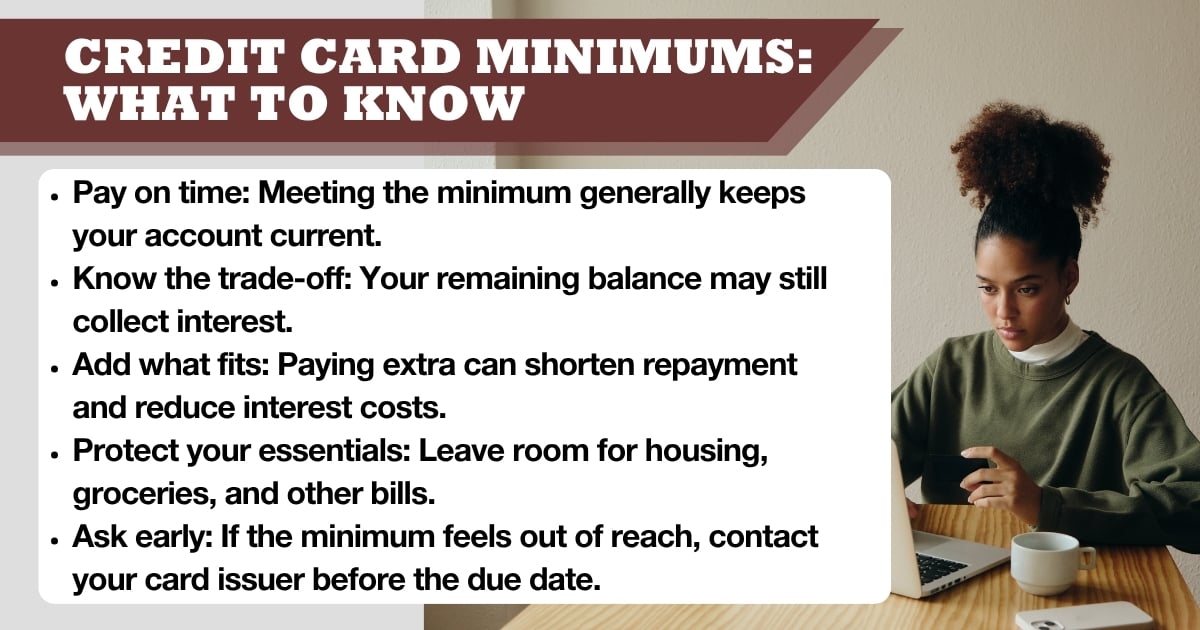
If even your minimum payment feels out of reach, you're not alone. Unexpected bills, changes in income, and other financial pressures can make it difficult to keep up. The important thing is to act as early as you can rather than wait until missed payments become harder to manage.
Here are a few steps to consider:
-
Contact your card issuer before the due date. Explain your situation and ask whether a hardship program, temporary payment arrangement, or other assistance is available. Options vary by issuer.
- Prioritize essential expenses. Make a plan for housing, food, utilities, transportation, and other necessities before deciding what you can afford to pay toward debt.
- Talk with a First Alliance Member Advisor. An advisor can help you review your finances and explore a manageable way forward.
- Consider nonprofit credit counseling. A reputable credit counselor may help you review your budget and understand possible debt repayment options. Your statement may include a toll-free number for credit counseling information.
When you're already stretched thin, a late fee can make catching up harder. Missing a payment may lead to fees and other consequences under your card agreement. If a payment becomes 30 or more days overdue, it may also be reported to the credit bureaus and affect your credit history.
If you think you might miss a payment, start with a conversation with your card issuer before the due date. Explain what you can afford and ask what assistance may be available. You don't need to have a complete repayment plan before asking for help.
Want to build your credit card knowledge?
Listen to Good Money Moves podcast Episode 44, "Beginners Guide to Credit Cards," for more beginner-friendly education on using credit cards.
Make Your Credit Card Minimum Payment Work for You
Think of your minimum payment as a floor, not a goal. It keeps your account in good standing while you figure out how much your budget can really put toward the balance. Come back to that number whenever your income or bills change, and raise it when you can. Even small increases add up over time.
When you’re ready to look beyond this month’s payment, our guide on how to pay off your credit card debt covers repayment strategies you can start with. If you’d like help building a plan around your budget, a First Alliance Credit Union Member Advisor can talk it through with you. No judgment, just guidance.
Whether you're working on paying down debt or making room for savings, a little guidance can help you decide what to try next. If you'd like more practical money tips, subscribe to the First Alliance Credit Union blog. We'll send our latest posts to your inbox, with plain-language explanations and manageable steps you can adapt to your budget.
Stay connected with First Alliance Credit Union and find your next helpful resource when you sign up for our blog.
