

For those new to online banking: click here to get started.
If you are asking yourself what should you do if you lose your job, the short answer is this: focus first on essential bills, unemployment benefits, health coverage, and contacting your lenders before making any big money decisions. Losing your job is stressful, and it is normal to feel overwhelmed. Knowing what to do after losing your job, even just the first few steps, can make the days ahead feel more manageable.
What should you do in the first 24 to 48 hours after losing your job?
In the first 24 to 48 hours, your goal is to gather information, not make big decisions. Give yourself permission to slow down before you act.
Here is what to focus on right away:
1. Get your final paycheck details and any severance information in writing.
Ask your employer exactly when your final paycheck will arrive and what it includes, such as unused commissions or bonuses. If you are offered severance, get the terms in writing before you sign anything, and take time to read it carefully rather than agreeing on the spot.
2. Ask your employer about your last day of health insurance coverage.
Your coverage may end on your last day worked, or it may extend through the end of the month. Knowing this exact date helps you figure out how much time you have to arrange new coverage, whether through COBRA, a marketplace plan, or a spouse's plan, without a gap.
3. Confirm whether unused paid time off will be paid out.
Many employers are required to pay out unused vacation time, though policies vary by state and by company. Ask for this in writing as well, since it affects how much you can expect in the short term.
4. Save any documents related to your termination or layoff, including emails.
Keep copies of your termination letter, any severance agreement, performance reviews, and email correspondence about your departure. These documents may be useful later, whether for unemployment benefits, or simply your own records.
5. Update your contact information with your former employer so you do not miss important mail.
Your W-2, COBRA paperwork, and other time-sensitive documents will likely be mailed to the address on file. If you are moving or your address is about to change, update it right aways so nothing gets lost.
This is not the time to make major financial moves like withdrawing retirement funds or taking out a new loan. Those decisions deserve more time and a clearer picture of your full situation.
How do you assess your cash flow after job loss?
You assess your cash flow by listing every dollar coming in and every dollar going out, starting today. This gives you a realistic picture of how long your money can stretch.
Start With What You Have
Before you can plan ahead, you need an honest starting point. Add up the following:
- Your checking and savings balances. Look at your actual available balance, not just what shows on your last statement, since pending transactions can change the real number.
- Any severance pay or final paycheck. Include the exact amount and the date you expect it to hit your account, since timing matters as mush as the total.
- Money owed to you, like reimbursements or freelance income. This includes expense reimbursements from your former employer, outstanding invoices, or any side income that is still coming in even though your primary job has ended.
Adding these together gives you a single number: how much cash you actually have on hand right now.
Then List What Is Going Out
Once you know what is coming in, the next step is understanding where your money goes each month. Many members find it helpful to use the free My Money tool built into First Alliance Online Banking. My Money sorts your transactions into categories automatically, so you can see where your money has been going without building a spreadsheet from scratch.
Review expenses such as:
- Housing costs: Rent or mortgage payments.
- Utilities: Electricity, water, internet, phone, and other essential services.
- Insurance: Health, auto, renters, homeowners, and other recurring premiums.
- Everyday necessities: Groceries, gas, transportation, and household essentials.
- Subscriptions and memberships: Streaming services, apps, gym memberships, and other recurring charges.
Once your spending is laid out clearly, you can make decisions based on facts instead of guesswork. You may notice expenses you had not thought about in a while, like a subscription you forgot to cancel or a category where spending has crept up over time.
Build a Simple Budget From These Numbers
This step is also the foundation of learning how to budget after losing a job. A budget built on real numbers, even a simple one, gives you back a sense of control.
Use the numbers you've gathered to:
- Calculate your monthly spending. Add up your essential and discretionary expenses to see your average monthly outflow.
- Estimate how long your savings will last. Compare your total cash on hand to your monthly spending to understand how many months your current funds can cover.
- Adjust your spending as needed. Prioritize essential expenses and reduce or pause nonessential spending while you search for your next opportunity.
Building a budget from these numbers helps you make informed decisions and gives you a clearer picture of your financial runway during your job search.
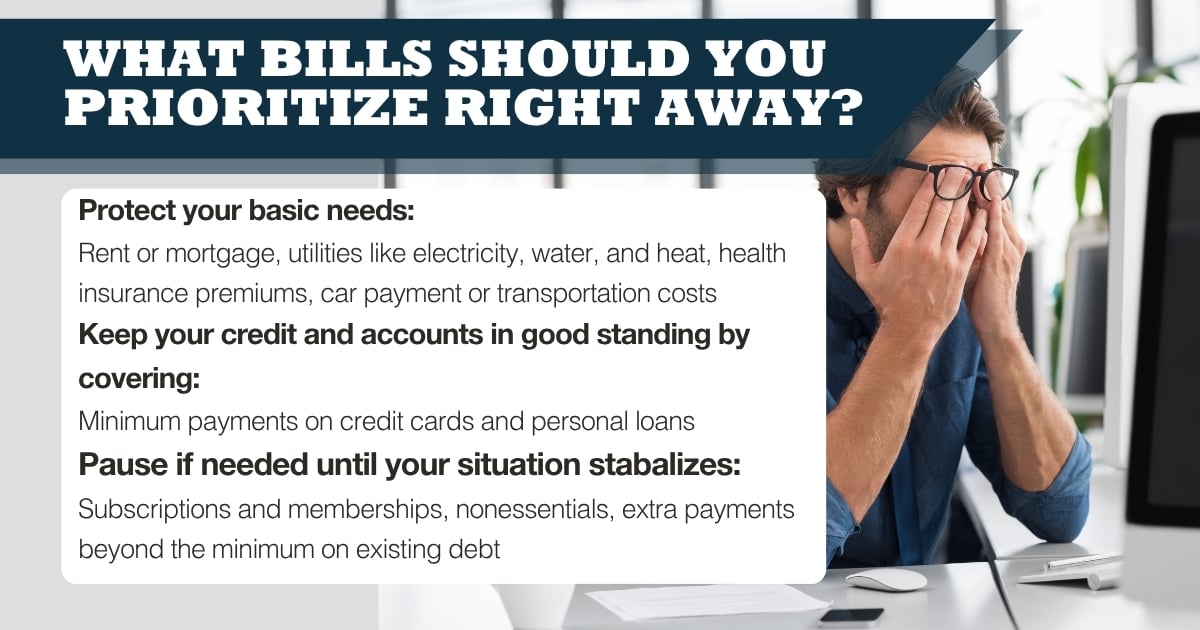
What bills should you prioritize right away?
The bills you should prioritize right away are the ones that protect your housing, your health, and your ability to earn income again. Not every bill carries the same weight when money is tight.
Priority #1: Protect your basic needs
When money is tight, it helps to know exactly where to put your limited funds first. The goal is to protect the expenses that keep a roof over your head, the lights on, and your ability to get to work on interviews. Missing these payments can lead to bigger problems down the road, like late fees, services shutoffs, or damage to your credit. Before covering anything else in your budget, make sure these costs are accounted for:
- Rent or mortgage payment
- Utilities like electricity, water, and heat
- Health insurance premiums, if you pay them directly
- Car payment or transportation costs, especially if you need your car for interviews
Priority #2: Keep your credit and accounts in good standing
Once your basic needs are covered, the next priority is protecting your credit and any accounts that carry ongoing obligations. Falling behind here will not shut off your lights right away, but it can still cause lasting damage, like dropped insurance coverage or a lower credit score that makes borrowing harder later. Cover these next, even if you can only manage the minimum payments:
- Minimum payments on credit cards or personal loans
- Auto or renters insurance
Priority #3: Pause if needed
These are the expenses with the most flexibility, and the ones you can safely scale back if money gets tight. Cutting them will not put your housing, utilities, or credit at risk, so they are the first place to look for extra breathing room in your budget. Once your basic needs and essential accounts are covered, consider trimming or pausing these until your situation stabilizes:
- Subscriptions and memberships
- Nonessential shopping or dining out
- Extra payments beyond the minimum on existing debt
If this list answers the question of what bills should I pay first after losing my job, the short version is this: keep a roof over your head, keep the lights on, and protect your health coverage first. Everything else can often wait or be renegotiated with a quick phone call.
When should you apply for unemployment benefits?
You should apply for unemployment benefits the same week you become unemployed, not after your savings run low. In Minnesota, unemployment insurance is administered by the Department of Employment and Economic Development through ui.mn.gov. The day you apply does not change how much you receive, but waiting to apply does delay your first payment.
A few things to know about unemployment benefits after job loss:
- Apply online at ui.mn.gov Sunday through Friday, or by phone
- Have your employment history for the last 18 months ready, including employer names, addresses, and phone numbers
- Expect a one week waiting period before your first payment
- Weekly benefits are based on your past wages, up to a state maximum, and are generally taxable
- Benefits are typically available for up to 26 weeks, as long as you keep meeting weekly requirements like requesting payments and searching for work
Applying quickly does not lock you into anything. It simply starts the clock on support tied to the work you have already put in.
What should you do about health insurance if you lose your job?
Losing your job does not have to mean losing your health coverage, but the clock starts ticking right away. You have a few main options for health insurance after losing your hob in Minnesota, and the right one depends on your budget and health needs. Do not let this decision sit too long, since coverage gaps can be costly, especially if you or a family member need ongoing prescriptions or care.
Your main options are usually:
1. MNsure
Minnesota's health insurance marketplace offers a 60 day special enrollment period after job loss, and may include tax credits or lower cost plans based on income. For many people, this ends up being the most affordable path forward, since the savings are tied directly to how much you are currently earning.
2. COBRA
This lets you keep the health insurance plan you had through your former employer, which can make sense if you want to avoid changing doctors, prescriptions, or coverage right away. The tradeoff is that COBRA is often more expensive, since you may now be responsible for the full monthly premium instead of just the portion you paid while employed. It can still be worth it if continuity of care matters more to you than cost.
3. A spouse or partner's employer plan
Often the simplest and most affordable path, if it is available to you. Many employer plans offer lower premiums than COBRA or marketplace coverage, especially if your spouse or partner's employer covers a large share of the cost. Job loss counts as qualifying life event for their plan too, so you can typically join outside of their employer's normal open enrollment window.
4. MinnesotaCare or Medical Assistance
Depending on household income, one of these state programs may apply. MinnesotaCare is for people who earn too much to qualify for Medical Assistance but still need affordable coverage, while Medical Assistance is Minnesota's Medicaid program for those with lower incomes. Eligibility is based on your current household income after job loss, not what you were earning before, so it is worth checking even if you think your income might be too high.
Job loss counts as a qualifying life event, which is what opens that 60 day special enrollment window outside the normal open enrollment period. Mark that deadline somewhere you will actually see it, since missing it means waiting for the next open enrollment period.
How can First Alliance Credit Union help during this transition?
If you are a First Alliance Credit Union member, reach out early to ask about available options, budgeting tools, and next step guidance. You do not have to wait until a bill is late to ask for help.
A few ways we can support you right now:
Review Your Checking and Savings Accounts
Talk with us about your Checking and Savings accounts to make sure your money is working as efficiently as possible during this stretch. We can walk through your current setup together, check whether you are paying any unnecessary fees, and see if moving funds between accounts could help you earn more or access cash more easily while you are between paychecks.
Build a Clear Picture of Your Spending
Use My Money inside Online Banking to build a clear, real time picture of your spending. This tool automatically sorts your transactions into categories so you can see exactly where your money is going each month without doing the math yourself. Having that visibility makes it easier to spot areas to cut back and plan ahead with confidence while your income situation changes.
Ask About a Personal Loan for Short Term Gaps
Ask about a Personal Loan if you need to bridge a short gap between paychecks. A personal loan can help cover essential expenses like rent, utilities, or groceries while you search for your next role, and our team can help you understand what terms and payment options make sense for your situation.
Set Up Account Alerts So Nothing Catches You Off Guard
Set up account alerts inside Online Banking so you always know your balances before a payment is due. You can customize alerts for low balances, upcoming due dates, and large transactions, giving you an early heads up before a payment surprises you. This small step can help you stay in control even when your income is less predictable than usual.
Losing a job can be stressful, but it doesn't have to derail your financial goals. If you're concerned about your finances, we're here to talk through your options and help you find a path that works for your situation.
Get more practical tips on navigating job loss—including smart financial strategies and next steps—from our team on Good Money Moves, Episode 38: What To Do If You Lose Your Job.
Frequently Asked Questions
No. Apply the same week you lose your job regardless of your savings, since your application date does not affect your benefit amount, and waiting only delays your first payment.
Yes, unemployment benefits are generally taxable income, so it helps to plan ahead rather than being surprised later.
You may still have options like MinnesotaCare, Medical Assistance, or local assistance programs. It is worth talking with a First Alliance team member about structuring your budget around a temporary income gap.
Before. Reaching out as soon as a payment looks tight almost always leads to more flexibility than waiting until it is already late.
Generally, only for essential, short term gaps, and only after comparing your options. A First Alliance team member can help you decide if a Personal Loan or Line of Credit fits your situation.
Ready to Take the Next Step?
Losing a job is hard, but you are not starting from zero. If you are wondering how to protect your finances after losing your job, it comes down to a few clear first steps: a realistic look at your cash flow, the right order for paying bills, and support from First Alliance Credit Union while you plan your next move.
If you are ready to talk through your options, from Online Banking tools to a Personal Loan, reach out to a First Alliance Credit Union team member today. We can help you build a plan that fits your situation.