


For those new to online banking: click here to get started.
If you lose your job, pay essential bills first, cut nonessential spending quickly, and contact lenders before you miss a payment. That's the short answer to how do you pay bills after losing a job.
Losing a job is stressful enough without worrying about which bill to pay first. If you're staring at a stack of due dates and a paycheck that's no longer coming, you're not alone, and you're not out of options. Job loss touches nearly every household at some point, and while the timing is rarely convenient, having a clear plan for your bills can turn a scary few weeks into a manageable stretch. This guide will help you figure out what to pay first, where you might have room to cut back, and when it makes sense to reach out to the people you owe.
Before you dive into the details, take a deep breath. You don't have to solve everything today. You just need to know your next few moves.
What Bills Should I Pay First After Losing My Job?
Pay your housing, utilities, and any bill tied to keeping your income potential intact first. If you're asking what bills should I pay first after losing my job, these are the payments that, if missed, create the biggest problems the fastest. Here's a simple order to work from:
1. Housing Payments
Rent or mortgage comes first. Losing your home adds a whole new layer of stress and cost you don't need right now. If you rent, talk to your landlord early about your situation. Some are willing to work out a short delay or a split payment, especially if you've been a reliable tenant.
2. Utilities Bills
Keep the lights, water, and heat on. Many utility providers have hardship programs, payment extensions, or budget billing options, but you have to ask. Waiting until a shutoff notice arrives limits your options, so reach out as soon as you know money will be tight.
3. Transportation Bills
If you need a car to get to interviews or a new job, keep that payment current if you can. This includes insurance, since a lapse can be expensive to fix later and can leave you without coverage right when you need reliable transportation the most.
4. Minimum Debt Payments
Credit cards, personal loans, and other debts should come next. Paying the minimum keeps accounts in good standing while you catch your breath, even if you can't pay the full balance right now.
5. Bills for Everything Else
Everything else means subscriptions, memberships, and nonessential spending fall to the bottom of the list until your income stabilizes. If you don't have enough in savings or through unemployment insurance to cover the first four bills listed, you need to drop these expenses until you get back on your feet.
This order isn't a rulebook set in stone. Your situation might call for adjustments. For example, if you're behind on a car payment but current on a credit card, it may make sense to protect the car first, since losing transportation can directly affect your ability to earn income again.
Which Expenses Can Wait or Be Negotiated After Losing a Job?
If you're wondering what expenses should you cut first after losing your job, start with nonessential subscriptions, memberships, and discretionary spending. Many recurring services also offer temporary discounts or pauses if you call and ask.
Take a look at what's coming out of your account each month and ask yourself honestly whether each expense is a need or a want right now. Streaming services, gym memberships, meal kit deliveries, and subscription boxes are easy places to pause or cancel.
It's also worth calling providers you assume are fixed costs. Internet, phone, and even some insurance providers will sometimes offer a temporary reduced rate or a payment plan if you explain that you've lost your job. The worst they can say is no, and asking costs nothing.
When you call, keep it simple. Explain that your income has changed, ask if there's a hardship plan or lower tier available, and ask what the process looks like to switch back once you're working again. A short, direct phone call can often save you real money within the same day.
How Do I Make a Bare-Bones Budget After Job Loss?
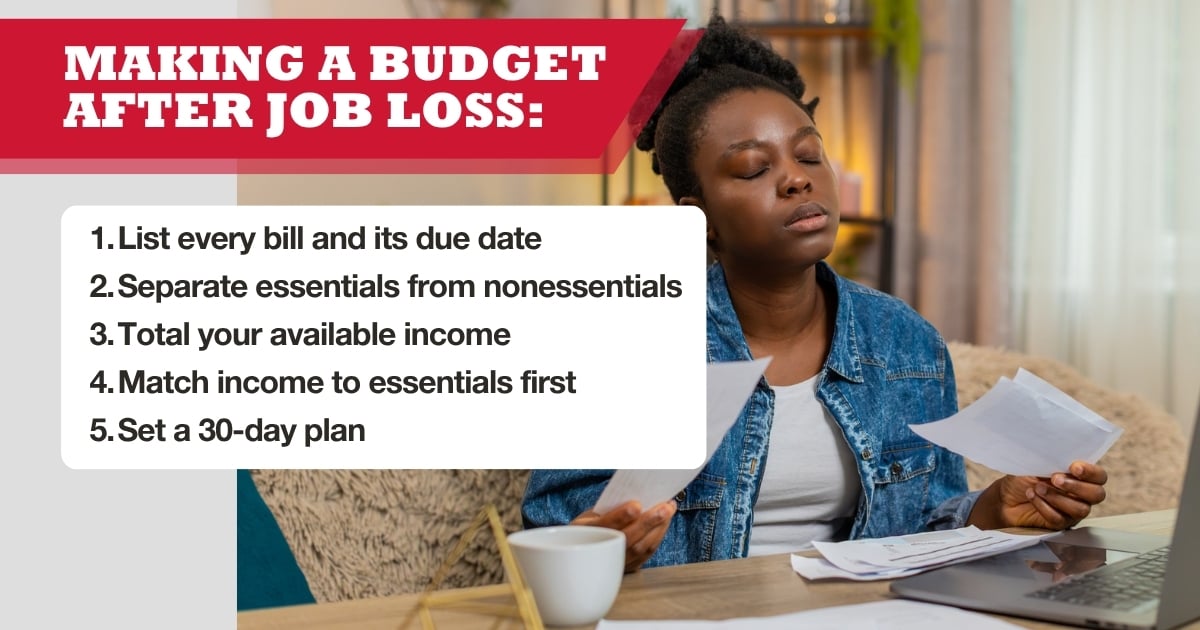
Knowing how to budget after job loss starts with one simple list. Write down every source of income you still have, then list only the expenses that are truly necessary to keep your household running. Cut or pause everything else until your income stabilizes.
Here's how to get started the same day:
Step 1: List Every Bill and Its Due Date
Write down every bill you have, including rent or mortgage, utilities, insurance, loan payments, groceries, transportation costs, your phone bill, and any recurring subscriptions. Next to each expense, note the amount due and the date it's due each month.
Having everything in one place gives you a clear picture of your financial obligations and helps you avoid missed payments or late fees. It also makes it easier to decide which bills need immediate attention and which ones you may be able to negotiate or postpone.
Step 2: Separate Essential from Nonessential
Go through your list and divide your expenses into two categories: essentials and nonessentials. Essentials are the costs that keep your household functioning, such as housing, utilities, food, transportation to job interviews or work, insurance, and necessary medications. Nonessential expenses may include streaming services, gym memberships, dining out, entertainment, premium subscriptions, or discretionary shopping.
Be honest with yourself during this step. Pausing or canceling nonessential spending isn't necessarily permanent, it simply creates more room in your budget while your income is limited.
Step 3: Total Your Available Income
Calculate every dollar you expect to have available over the next month. This may include unemployment benefits, severance pay, a partner's income, freelance or part-time work, government assistance, or savings you've decided to use.
If you haven't applied for unemployment benefits yet, do so as soon as possible after your job ends. Processing times can take several weeks, and many states don't pay benefits for the period before your application is submitted. Knowing exactly how much money is coming in allows you to make informed decisions about what you can realistically afford.
Step 4: Match Income to Essentials First
Now compare your available income to your list of essential expenses. Start by covering your highest-priority needs, including housing, utilities, groceries, transportation, insurance, and any other costs that allow you to maintain your health, safety, and ability to search for work.
If your income isn't enough to cover everything, identify where you may be able to negotiate payment plans, request temporary hardship assistance, defer certain bills, or use emergency savings strategically. Focusing on essential first help your stretch your available resources while minimizing financial damage.
Step 5: Set a 30-Day Plan
Instead of trying to predict exactly how long you'll be out of work, create a budget for the next 30 days. This shorter planning window makes it easier to a apt as your circumstances change, whether that means receiving unemployment benefits, finding temporary work, or securing a new job.
At the end of each month, review you income, expenses, and progress, then update your budget based on your current situation. Regular check-ins help you stay in control and make adjustments before small financial issues become larger ones.

When Should I Call Lenders or Service Providers If I Can't Pay on Time?
It is important to call your lenders and service providers before you miss payment, not after. Most companies have more flexibility to work with you when you reach out proactively rather than after an account is already past due.
If you're not sure how to talk to creditors after losing your job, keep it simple. A lot of people put off this call because it feels uncomfortable, but creditors deal with job loss and income gaps all the time. They would rather work out a plan with you than send your account to collections. When you call, be ready to explain your situation briefly and ask directly what options are available, whether that's a deferred payment, a reduced payment, or a temporary hardship program.
A short script can help take the pressure off the conversation. Something like, "I recently lost my job and want to stay current on this account. Do you have any hardship options, payment plans, or temporary deferments available?" gets straight to the point. Write down the name of the person you speak with, the date, and any agreement you reach, in case you need to reference it later.
If you have a loan with First Alliance Credit Union, you don't have to navigate this alone. Reach out early, and we'll sit down with you to find a plan that fits your situation. Our member solutions team is here to help!
Should I Use Emergency Savings, Credit Cards, or Retirement Money to Cover Bills?
Use emergency savings first if you have it. Credit cards can bridge a short gap but come with interest cost. Retirement funds should generally be an extreme last resort, since early withdrawals often come with penalties and long-term costs that can outweigh the short-term relief.
Think of your options in order of cost.
-
Emergency savings cost you nothing extra to use, so that's the first place to look.
-
Credit cards come next, since they're accessible but carry interest that adds up quickly of you're not able to pay the balance off soon.
-
A personal loan can sometimes fall between these two options, since it typically has a lower rate than a credit card and a predictable, fixed payment.
-
Retirement accounts should generally stay untouched unless you've exhausted other options, since early withdrawals can come with taxes, penalties, and a real setback to your long-term goals.
If you're figuring out how to pay bills when you lose your job and have no savings, a personal loan with a low, fixed rate can sometimes be a more manageable option than high-interest credit card debt for covering a short-term gap. It's worth comparing your options before assuming credit cards are your only choice.
How First Alliance Credit Union Can Help During a Job Loss
You don't have to figure this out on your own. As a member, you have access to tools and people who can help you get through a temporary income gap.
Online Banking & Checking Account
Your Online Banking and checking account work together to make it easy to track every dollar coming in and going out, so you always know where you stand. You can check your balance in real time, review recent transactions, set up alerts for low balances, and move money between accounts without a trip to the branch. When income is unpredictable, having that kind of constant, on-demand visibility helps you avoid overdrafts and catch problems before they become bigger ones.
My Money
My Money tool gives you a clear picture of your spending by pulling all of your accounts into one place inside Online Banking. Instead of digging through paper statements or logging into multiple apps, you can see exactly where your money is going and build a realistic budget based on real numbers, not guesswork. During a job loss, that visibility matters most: it helps you spot non-essential expenses you can pause, confirm how long your savings will last, and plan month to month with confidence.
Anytime Skip-a-Pay
If you have an auto loan or personal loan with First Alliance Credit Union, you may be eligible for our Anytime Skip-a-Pay program. Eligible members can defer up to two loan payments per calendar year, per qualifying loan, which may create some breathing room in the budget after a job loss. Because your loan must be current to use this option, reach out as soon as you anticipate having trouble making a payment.
If you're a First Alliance Credit Union member, reach out early to talk through payment concerns and available tools for managing your budget. Our team would rather help your find a plan than watch you fall behind.
Job loss is easier to talk through than figure out alone. Hear our Chief Revenue Officer, Andrea Allen, break it down on the Good Money Moves podcast Episode #38: What To Do If You Lose Your Job
Frequently Asked Questions
Plan in 30-day increments and revisit your budget at the start of each one. This keeps your plan realistic without requiring you to predict exactly how long your job search will take.
No. Reaching out to ask about hardship options or payment plan doesn't affect your credit. What can affect your credit is missing payments without any communication, so a proactive call is almost always the safer move.
For many people, yes, at least temporarily. Redirecting that money toward essential bills can help you avoid higher-cost debt or an early retirement withdrawal, both of which tend to cost more in the long run.
Bottom Line
Losing a job is hard, but how you handle the weeks that follow makes a real difference. Prioritize housing, utilities, and transportation. Trim what you can. Build a simple 30-day budget. And reach out to lenders and service providers before payments are late, not after. None of this makes job loss easy, but having a clear plan can make the financial side of it feel far less overwhelming.