<img src="https://events.xg4ken.com/pixel/v2?tid=KT-N2BAB-3ED&amp;noscript=1" width="1" height="1" style="display:none">
Skip to the main content.

5 min read

Why Credit Unions Are Different: The Member-First Advantage

Why Credit Unions Are Different: The Member-First Advantage

If you have ever felt like just another account number at your bank, that feeling is more common than you might think. A lot of people start asking questions once they notice the fees, the wait times, or the sense that decisions about their account are being made somewhere far away from their actual branch. That is one of the biggest reasons people start asking why credit unions are different from traditional banks in the first place.

The short answer is ownership. But what that really means for your day to day money life is worth breaking down, because it shows up in ways you can actually feel.

What Makes a Credit Union Different From a Traditional Financial Institution?

Banks answer to shareholders. Credit unions answer to members, and members are also the owners. Banks are for-profit companies, so shareholders expect a return on their investment. Credit unions are not-for-profit cooperatives, so there are no outside shareholders expecting a payout.

That structural difference shapes how each type of institution is set up to operate.

Factors Banks Credit Unions
Ownership Shareholders Members (You!)
Structure For-profit Not-for-profit cooperative
Who decisions serve Shareholder returns Member needs
Earnings Paid out to shareholders Reinvested into member products and service

This is the heart of the member-first credit union model. When the people using the institution are also the people who own it, decisions naturally lean toward what helps members, not what maximizes profit for outside investors.

Why Are Credit Unions Considered Member-First?

Being member-first is not a slogan. It shows up in three practical ways that matter for your everyday finances.

Member ownership

Since credit unions are not-for-profit and member-owned, earnings get reinvested into lower fees, better service, and improved products instead of paid out to shareholders. That is one of the clearest benefits of a credit union for anyone tired of paying for someone else's return.

Local decision-making

When you call or walk into First Alliance Credit Union, you are talking with people who can actually make decisions, not a call center reading from a script three states away. Loan approvals, account questions, and everyday service decisions happen close to home, which means faster answers and solutions that fit your actual situation.

Products built around member needs

Instead of designing accounts to squeeze out extra fees, we build tools meant to help members build financial footing. Our WINcentive Savings Account is a good example. It rewards consistent saving habits with entries into a prize drawing, turning a habit that can feel tedious into something a little more motivating.

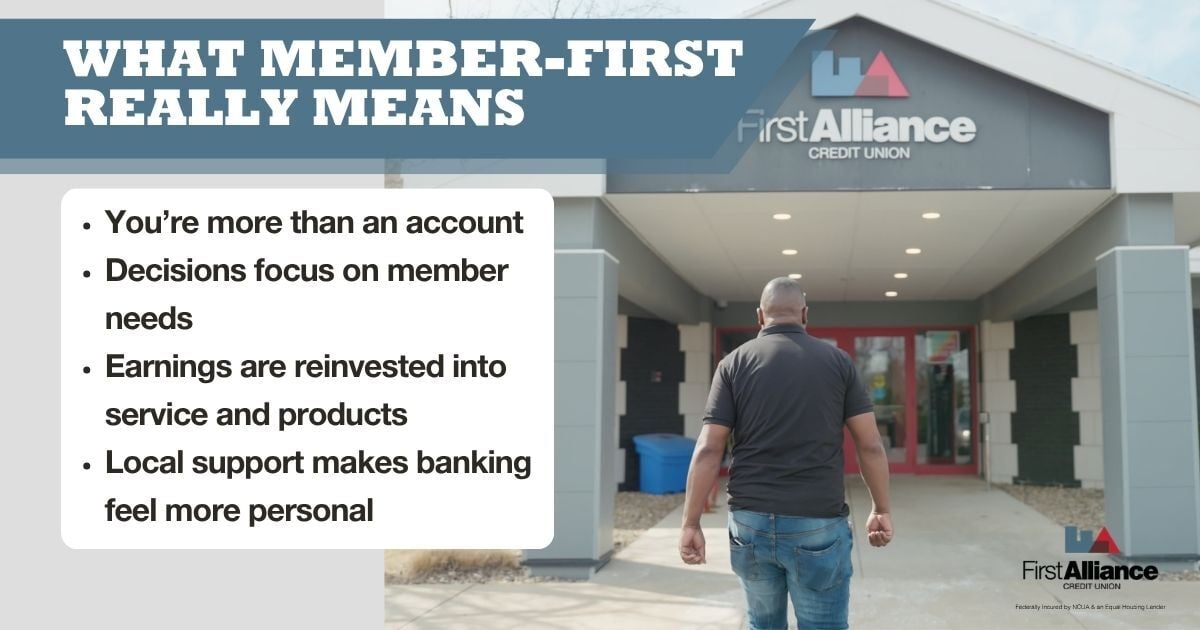
What Member-First Really Means, man walking into First Alliance Credit Union building

How Does Local Decision-Making Benefit Members?

Local decision-making means the person helping you understands your community and has the authority to work with you directly. If you are rebuilding credit, going through a rough patch, or just have a question that does not fit neatly into a policy manual, you get a real conversation instead of a form letter. Our team can look at your full picture and help you find a path forward, whether that is through budgeting guidance, a savings plan, or a loan option built for where you are right now.

That kind of flexibility is hard to find at larger institutions where front-line staff often cannot deviate from a national playbook. It is one of the quieter but most meaningful benefits of a credit union.

Are Credit Unions Better for Everyday Banking Needs?

For most people, yes. Everyday banking is not just about the fine print. It is about whether your checking account has fees that sneak up on you, whether your mobile banking app actually makes your life easier, and whether someone picks up the phone when you need help.

Because credit unions are not chasing shareholder profit, everyday accounts tend to be built around simplicity instead of fee income. That shows up in things like checking and savings accounts, mobile banking that fits into how people actually manage money day to day, and short-term loan options for members who need fast access to funds without a credit check. None of that is unique to any one institution, but it reflects the kind of everyday banking a member-first structure tends to produce.

Why Should You Switch to a Credit Union?

If any part of this sounds like what you have been missing from your current bank, switching is worth considering. People often assume changing financial institutions is complicated, but it does not have to be.

Here are 4 signs it's time to switch to a credit union

Here are four signs it may be time for a change. If managing your money at your current bank feels more frustrating than supportive, these are some of the clearest clues that it may be time to look for an option that feels easier, more personal, and better aligned with your needs.

1. Fees That Keep Adding Up

If you are paying fees on your accounts, it's likely that other institutions do not charge them, that is a reasonable reason to start looking elsewhere. A member-owned structure tends to shape how a credit union uses fees, this means there tends to be fewer fees charged overall, and when fees are assessed they tend to be lower than a traditional bank.

2. A Location That No Longer Fits

If you have moved, or your daily routine has changed, you may want a financial institution that is closer to home or work to make deposits more convenient or to ensure you can access in-person support when you need it.

3. Services You Wish You Had

If your current bank does not offer the services, account types, or technology you need, that gap is worth paying attention to. Finances are already stressful and complicated, a good credit union can make you feel in control of your money.

4. Customer Service That Falls Short

If getting a straight answer from your bank feels harder than it should, that is often one of the clearest signs it is time for a change. If your stuck talking to endless chat bots or automate phone centers, a good credit union will connect you with a real person quickly and get you the support you need. 

Switching itself is more manageable than most people expect. It typically comes down to a few steps: opening a new account, moving your money over, and updating your direct deposit and automatic payments so nothing falls through the cracks. Running your old and new accounts side by side for a month or two makes the transition smoother, since it gives you time to confirm everything has moved before closing anything out.

Our free Switch Kit walks you through the process step by step, from setting up direct deposit to updating automatic payments, so you are not left untangling old accounts on your own.

What Makes a Credit Union Different From Banks, in Practice

Pulling it all together, the member-first advantage is not one single feature. It is a combination of who owns the institution, who makes the decisions, and what those decisions prioritize. That combination is why credit unions are better for members who want their bank to feel more like a partner and less like a transaction.

At First Alliance Credit Union, that plays out through:

  • A structure where members are owners, not customers being sold to
  • Local teams empowered to make real decisions to help members
  • Products like the WINcentive Savings or Rate Reboot programs built around actual member needs
  • Support that meets you without judgment, wherever you are financially

 Curious how this plays out day to day? Watch Episode 37 of Good Money Moves, "What Makes Credit Unions Better Than Banks," for a closer look at what member ownership means in practice. 


Frequently Asked Questions

The Bottom Line

Why credit unions are different comes down to a simple idea. When the people banking with an institution are also the ones who own it, everything from fees to service tends to shift in your favor. If you want a smoother, more supportive way to manage your money, First Alliance Credit Union may be a better fit for your financial life. Use the button below to start making good money moves as a credit union member today!

Celebrating Two WINcentive Savings Winners

1 min read

Celebrating Two WINcentive Savings Winners

First Alliance Credit Union is proud to announce that two of its members, both also long-time employees, were prize winners through the annual ...

Read More
Overlooked Resources at First Alliance Credit Union

1 min read

Overlooked Resources at First Alliance Credit Union

If you’re a member of First Alliance Credit Union, you already know about some of the great benefits you get access to, such as exceptional service...

Read More
Apply to Win $1000 Minnesota Scholarships

1 min read

Apply to Win $1000 Minnesota Scholarships

A great benefit of being a First Alliance Credit Union member is that students can apply for the Minnesota Credit Union Foundation Scholarship....

Read More